TT Epaper LHS
The Telegraph
TT Mobile
 
 
IN TODAY'S PAPER
WEEKLY FEATURES
CITY NEWSLINES
FEEDS
  RSS
  My Yahoo!
ARCHIVES
Since 1st March, 1999
 
THE TELEGRAPH
 
CIMA Gallary
 
Email This Page
Portrayal of human predicament

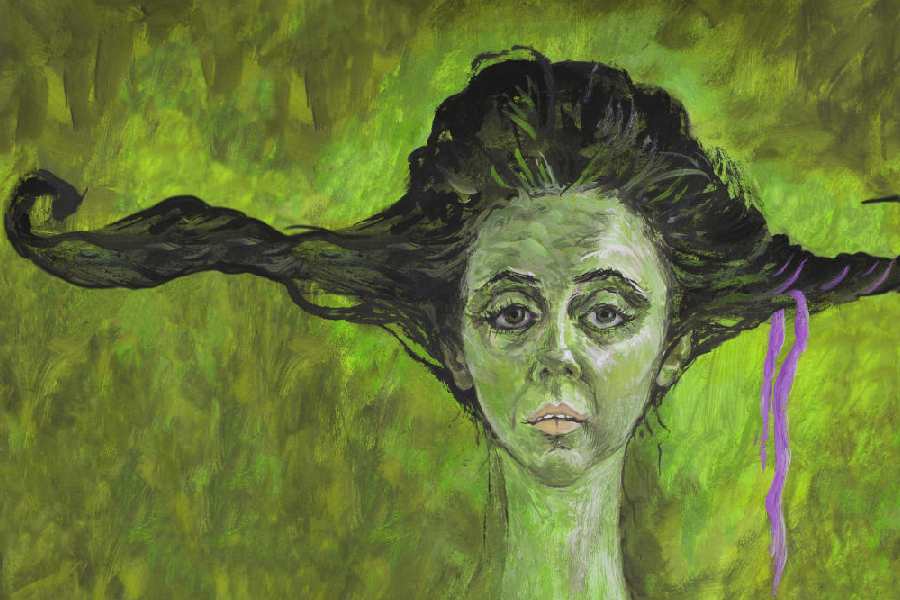
Jogen Chowdhury has been intensely engaged in linear art since he came back from Delhi in 1987 to settle down at Santiniketan. But even his earlier works, including sketches of refugees at the Sealdah station, betrayed his natural predilection for linear expression. Throughout his career, Chowdhury has striven to bring out the pictorial potential of linearity and thus demonstrate the power of ink, brush and pastel to create a complete and independent art form. Speaking of his favourite form ? painting in mixed media ? Chowdhury once said he had derived it from drawing, adding that one really starts appreciating a work of art only when one is able to appreciate it in its simplest (and often most articulate) expression.

A true work of art must establish itself as a significant design even before it takes its final shape. Small wonder, Chowdhury still acknowledges his indebtedness to Kathe Kollwitz whose lithographs he had seen at an exhibition.

Quite expectedly, the current exhibition of Chowdhury?s works at the Chitrakoot Art Gallery is full of figural drawings with a difference. The serious viewer of these works will do well to remember what the artist says about the purpose of drawing: ?It?s not just making figures or clothes (which are mostly representational), but making the drawing of figures or clothes purposeful.?

The exhibition was inaugurated with the release of a well-compiled and well-edited book on the artist, published by Masanori Fukuoka of Glenbarra Art Museum, Japan, comprising the gallery?s collection of the artist?s work.

A legend in his lifetime, Paritosh Sen is still busy at his easel. His early years in Madras Art School, under the tutelage of Debiprosad Roy Chowdhury, taught him how to make a pictorial structure stand on its own merit. But his virtuousity in draughtsmanship experienced several twists and turns during his stay as a student in Paris during the early 1950s when the likes of Picasso, Matisse and Chagall were defining art, while bubbling young Indian artists like Nirode Mazumdar, Raza, Ram Kumar and Padamsee were avidly absorbing the new aesthetic idiom evolving in the West.

Picasso, in particular, was Sen?s reigning icon and has remained so, long after the master has departed and Sen?s own milieu has compelled him to innovate newer ways of interpreting his perceived pictorial, socio-political and romantic-erotic situations. In the process of his evolution, he has shown how to absorb a variety of influences without losing his one?s identity.

Although Sen paints and exhibits prolifically, what is apt to strike one is that he grapples with an increasing variety of themes involving newer ways of formal treatment and with an eye to novel ways of mixing colours ? a quality which was admired by no less an artist than Picasso himself. The structural solidity of Sen?s composition has stood him in good stead and allowed him to creatively distort his animal and nude portrayals.

An offshoot of these rare skills may be seen in Sen?s many pictorial commentaries on politically charged situations and human predicament the world over. His recently concluded exhibition at the Academy of Fine Arts constitutes a profile of his courage in the face of inhumanity, tyranny and injustice.

Top
Email This Page