|
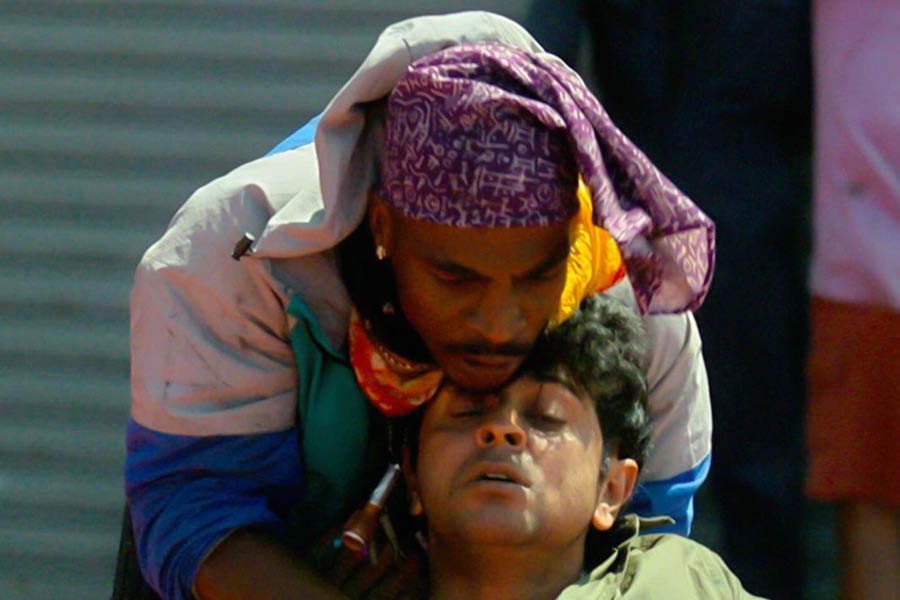
| WATERWORLD: A video grab of a tsunami wave |
Tsunami enters lexicon of terror
The contribution of ordinary British people for the
tsunami victims, heading towards ?100 million, is in character. No nation is more
generous when it comes to helping those in trouble. What partly persuaded even
pensioners to donate their pensions was the moving reporting by the BBC and ITN.
When one weeping woman clung to BBC?s Ben Brown, he
wasn?t embarrassed at all as Englishmen of a bygone generation would have been.
He simply put a comforting arm around her.
The BBC?s policy of promoting cultural diversity among
its staff paid off. Its Sri Lankan-born news presenter, George Alagiah, flew from
London to Colombo and located the house, now destroyed, where his grandfather
had lived and where Alagiah himself had spent childhood holidays.
Who lived and who died was a lottery. Well known to
me is the Colombo-born Nirj Deva, a Tory Member of the European Parliament for
southeast England. He had gone to see his mother and was preparing for a quick
dip when he glanced out of the window of his beach hotel.
?I could not believe what I was seeing,? he said.
?A massive wave was roaring toward the shore.? But ?my feelings of grief and disbelief
have now begun to subside, and I am beginning to feel angry,? added Nirj, a Tory
spokesman in Strasbourg on overseas development.
Could lives have been saved? Nirj?s questions include:
?Did the US National Oceanic and Atmospheric Administration know what was happening?
Is there any truth in rumours that warnings were suppressed in some countries
for fear of damaging the tourist industry??
Actually, I wasn?t unfamiliar with the word ?tsunami?,
because a few months ago one struck Japan, where my nephew went last summer to
teach English. I rang my brother who assured me he had spoken to his son who was
fine because ?the tsunami had hit another part of Japan?.
But now in England, tsunami has replaced 9/11 as shorthand
for the new horror.
|
| BEND IT LIKE... Archie Panjabi |
Return to Rugby
Poor Salman Rushdie. After watching a television dramatisation
of the 1857 Thomas Hughes novel, Tom Brown?s Schooldays, on ITV over the
New Year holidays, I can sympathise with him. Having left the familiarity of Cathedral
School in Mumbai, Salman arrived in 1961 at the age of 14 at Rugby, the famous
British public school in Warwickshire where, according to legend, rugby football
was born in 1823.
Watching the adaptation, in which the fine actor Stephen
Fry is cast as the wise headmaster Dr Thomas Arnold, Rugby?s version of our own
Father Murphy at St Xavier?s in Patna, I can well understand why Salman had a
miserable time at Rugby.
In the 90-minute film, we see the vulnerable little
Tom Brown being mercilessly tortured by Flashman, the loathsome school bully.
The graphic bullying scenes so upset my wife that she declared she could not bear
to watch any more.
?Rugby was tough,? Salman would recall later. ?Cambridge
I had a very good time at, but coming to Rugby was really quite brutal. I was
not quite 14 and taken aback to be made to feel like a foreigner, which, until
that point, I had never thought of myself as. I did experience certain amounts
of racial discrimination ? not from the staff, from some of the other boys. And
that was shocking and depressing. And so I remember my school days as not being
particularly happy. I was bad at games. I think it was the triple whammy: foreign,
clever, bad at games.?
I have been wondering whether there is an equivalent
of Tom Brown?s Schooldays in Indian literature or whether it is only English
public schools which leave a permanent mark on their pupils. It is perhaps because
he went to Rugby that Salman was able to emerge relatively unscathed from the
dark days of the fatwa.
|
| ROLE PLAY: Stephen Fry |
Moving Muslims
We all loved Archie Panjabi as the sister of the football-mad
Jess in Bend It Like Beckham. One of the new generation of talented British actresses,
Archie now plays the title role in Yasmin, a disturbing new movie which Channel
4 is screening on January 13. It is worthy of a release in India and Pakistan
for it shows how the Bush/Blair ?war against terror? following 9/11 is poisoning
the relationship between British Muslims and the wider community.
This story is set in Yorkshire where Yasmin Hussein
is a young woman of Pakistani origin, forced by her father to marry a cousin to
get him into the UK. She inhabits two cultures, switching between hijab and tight
jeans as the occasion demands. But in the aftermath of 9/11, the Hussein home
is raided by armed police looking for terrorists.
Of course, they find none but the police heavy-handedness
drives a once Westernised Yasmin towards Islam, while her younger brother, Nasir,
heads off for Palestine to fight for his ?brothers?.
In the original script by Simon Beaufoy, who wrote
The Full Monty, Yasmin was going to end up as a suicide bomber. But this was ditched
after being considered unnecessarily provocative. ?I?m going off for a drink ?
you fancy coming?? an Englishman from work asks her. To which, Yasmin, the reborn
Muslim, responds: ?I?m going to the mosque ? you fancy coming??
Not quite game
In one respect, I am out of tune with the new England.
There was a time long ago when the BBC television
carried live coverage of Test cricket. ?Oh, just one more over,? I would say to
myself, when I should have been more gainfully employed. And then, ?Let me just
see one more over from the other end.? Over by over, hours would happily pass.
Now, Test match coverage has been relegated to satellite
TV which I don?t have or want. Even BBC Radio 4 doesn?t have ?running commentary?.
Personally, I think the rise in violent crime in England is explained by the decline
in cricket. Didn?t the English always teach us that cricket was a civilising influence?
|
| FRENCH PUBLICITY: Aishwarya Rai |
Power play
A men?s magazine, GQ, has ranked Iqbal Sacranie as
number 10 in the list of the 25 most powerful men in Britain. Malawi-born Sacranie,
53, an accountant, is the secretary-general of the Muslim Council of Britain and
is the first port of call for British journalists requiring a quick comment on
any story with an Islamic angle.
He came to prominence during the early days of the
Rushdie crisis when I marked him out as an upwardly mobile Muslim. He carried
two mobile phones (?Can you please hold on, I?m on the other mobile?? I imagined
him saying).
Tony Blair tops the list but, tongue in cheek, GQ
has identified the second-most influential man in Britain as George Bush. Mind
you, veteran Labour Left-winger Tony Benn would reverse that order. During the
Gulf War, when many accused Blair of being Bush?s poodle, Benn quipped: ?When
you telephone Downing Street, you get put through to the White House.?
Tittle tattle
Just when we thought France was an Aishwarya-free
zone, the ubiquitous ?ex-Miss Monde? has made the cover of L?Express, a
magazine which has done a 64-page special report on India.
|