|
The first classes in architecture were started at
the Sir J.J. School of Arts in 1900 under the guidance of John Begg, the first
consulting architect to the Government of Bombay. In 1917, the Bombay Architectural
Students? Association was formed comprising past students of the school. The influence
of the school and the association had increased so much that in 1929, the association
was reconstituted as the Indian Institute of Architects, to serve the interests
of the profession on a nationwide scale.
In 1952, the college was affiliated to the University
of Mumbai for teaching the course leading to a bachelor of architecture (BArch)
degree. Later on, a master of architecture (MArch) degree course was also introduced.
The college is recognised by many national and international associations and
students graduating from it are admitted to postgraduate courses all over the
world.
The notification for the BArch programme is published
in May. You can collect the prospectus and the application form from the institute?s
office at Sir J.J. School of Architecture, 78/3 Dr. D.. Road, Mumbai 400 001.
Eligibility: You should have passed the higher
secondary school certificate examination or an equivalent exam with at least 50
per cent marks in the aggregate in physics, chemistry and mathematics and statistics.
You also have to appear for the aptitude test conducted by College.
A student who has passed the 10+2 or an equivalent
examination from a board other than HSSCE Maharashtra, will be required to produce
a certificate of eligibility from the registrar of this university for the purpose
of admission to the BArch degree course.
Candidates are advised to obtain the certificate of
eligibility after they are offered admission to the course.
Courses offered: The institute offers courses
in BArch, MArch and other short-term courses in computer education.
Entrance exam
The entrance test is held in May?June every year in
cities all over the country. The aptitude test marks are added to the marks you
obtained in physics, chemistry and mathematics in the Plus Two qualifying examination.
The aptitude test carries 40 marks and 60 marks is devoted to your Plus Two examination
results.
Pattern of exam
The aptitude test is conducted in the following subjects
(minimum pass marks is 16 out of 40): 1. The first paper, which is on aesthetic
sensitivity, is of one hour?s duration and carries 15 marks. 2. The second
paper, which is on drawing, is of two hours? duration and carries 25 marks.
How to prepare
Creativity and imagination have to be your strong
points. You should also know how to be radical in your ideas. At the same time,
you must be practical enough to create original and inspiring work. You should
be comfortable with three dimensions, spatial flow, have a curious mind, creative
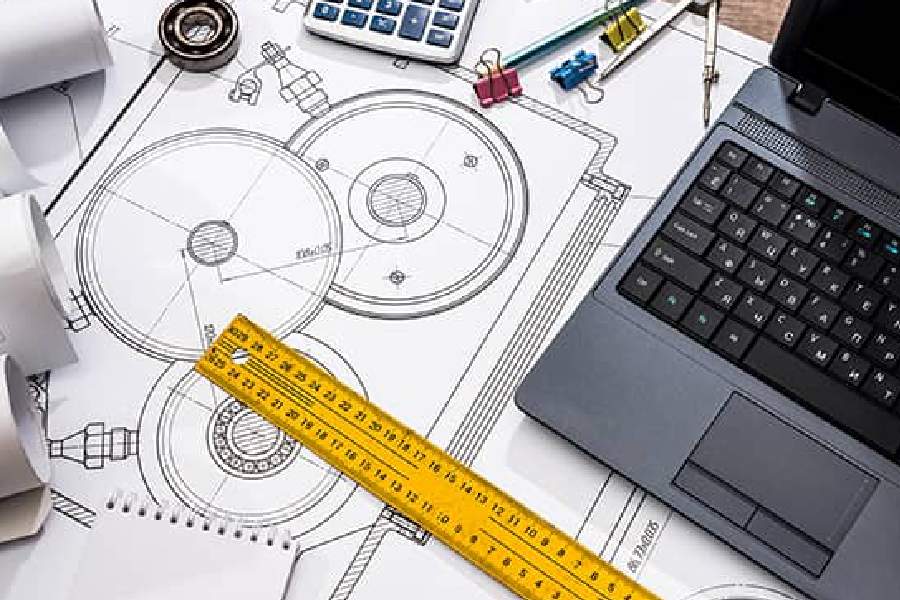
thinking, a flair for drawing (including computer-aided design, since most architectural
design work is done on computers). Concentration is also an essential requirement.
Therefore, go through architecture magazines like Inside Outside and closely
observe construction sites to be able to reproduce the drawing on paper as accurately
as possible. You need to sharpen your power of observation and practise sketching
and shading.
sample test paper
Sketch any two of the following:
a) Gates
b) Fences
c) Pipes
d) Stained glass windows and the requisite background
Create a basic 3D object like a sphere and then move
it away from you and redraw it.
Draw from memory a free-hand pencil sketch in black
and white of a cricket match. The sketch with shades and shadows should have human
figures to express scale and proportions.
|