|
|
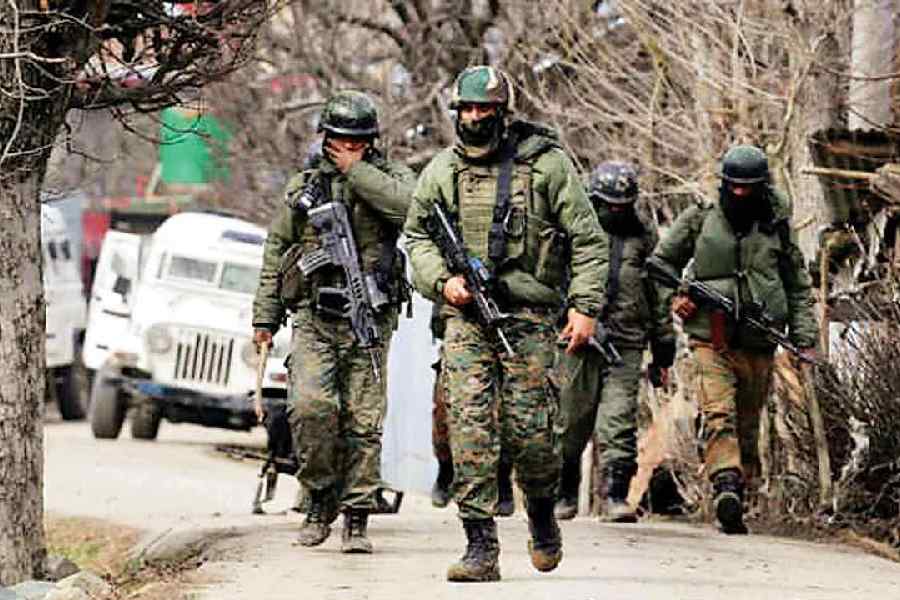
Troops from the Darualaman Garrison drive past a graveyard of war waste in Kabul
|
Kabul, Oct. 20: A tight slap on the back from his officer sends Wali Ahmed reeling, his Kalashnikov nearly falling off his shoulder. He was giggling while in a parade, goose-stepping with his comrades-in-arms at the Kabul Military Training Centre grounds where a multinational force is mentoring a new Afghan National Army (ANA). Ahmed could not maintain a stern expression and became camera conscious when a photographer went up close to capture him in the frame.
Easily distracted, the 19-year-old from Badakshan in Afghanistan?s northeast is just a two-week old recruit into the ANA. After 10 weeks of drills and parades and sessions at a firing range, he will go on a 20-day leave and return to be deployed with the army?s units.
?Many of them know how to fire a gun, few know how to take aim and shoot,? says an officer with the US army?s taskforce Phoenix that is at the nucleus of the multinational force raising the Afghan army.
Many of those who have just joined the army have some experience in guerrilla warfare but lack the discipline.
Recruits at the KMTC ? the only military academy in the country ? try hard to march in step with the band. By the standards of professional armies, the ANA is currently a higgledy-piggledy bunch, not trained for war but war weary all the same.
The office of military cooperation that oversees the training wants to add an average of 800 soldiers to the ANA every two weeks, a phenomenal rate of recruitment for any professional army. The objective is to raise a force of about 45,000. By rough estimates there are about 85,000 militiamen from warlords? armies and the Taliban roaming the Afghan countryside even now.
Inside Camp Phoenix on the outskirts of Kabul, where the multinational trainers are based, there are Humvees ? troop carriers from the US army ? mounted with medium-range machine guns, Mahindra Bolero jeeps donated by India and teams from Nato nations.
But, says Brigadier General Richard Moorhead, head of taskforce Phoenix, the recruits are trained and led into battle by Afghan officers, with a representative from one of the more professional armies accompanying them on missions.
Desertion rates were high in the first few battalions trained last year with many not returning from their leave after the training. In the recent weeks leading to the October 9 elections, however, the ANA was ordered into the thick of action and in just two months, recorded 12 casualties.
In Kabul, at the Darualaman Garrison where the counting centres are located, ANA soldiers sloppily man checkpoints in comparison with the tense and raring-to-go US army soldiers.
The ANA is some 14,000 strong and in the weeks leading to the poll, some 6,700 troops were deployed for missions against the Taliban and the militia of warlords. The army has been given a Nato-like structure. Each battalion of about 600 soldiers will have 100 officers, while its brigades will comprise about 2,800 soldiers.
Brigadier General Ghulam Asifi, commandant of the Kabul training centre, passed out of the academy in 1968 and later trained with the Soviets and in the Indian Army?s school of artillery in Deolali, Maharashtra.
What Asifi and the ANA?s multinational mentors are trying to ensure is that the Afghan army is brought up with the right ethnic mix. Recruits are being drawn in from among Pashtuns, Tajiks, Uzbeks, Hazaras and the rest of Afghanistan?s often warring tribes to keep the army as apolitical as possible.
The ANA will have its task cut out once the US-backed government is legitimised after the election results are declared. Karzai, if indeed elected President without the prefix ?interim? to his office, will be banking heavily on the army in his battles against the warlords.
In preparation for that drive, the army has already been deployed in five regional commands based in Kabul, Gardez, Kandahar ? facing the disputed Durand line with Pakistan ? and in Herat and Mazar-e-Sharif to the west.
|