|
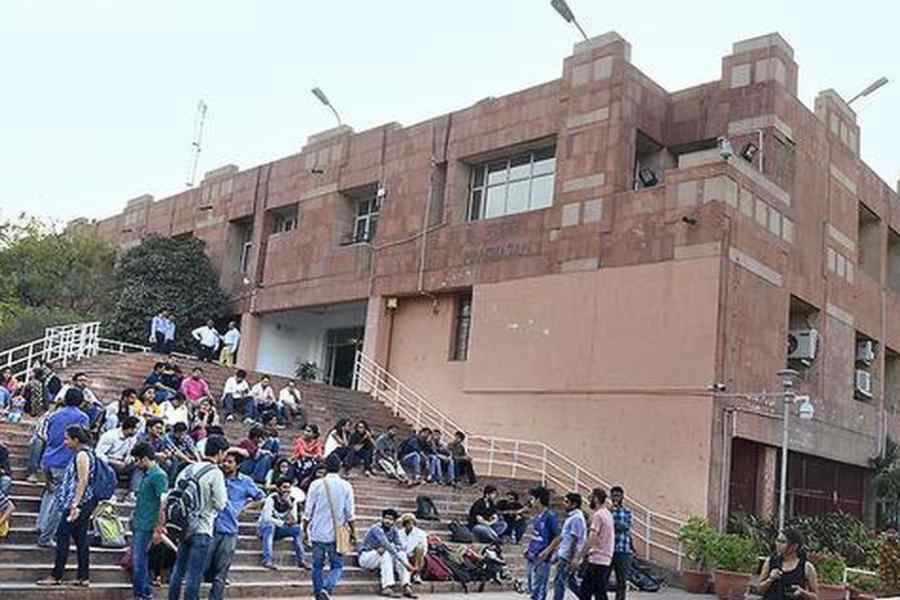
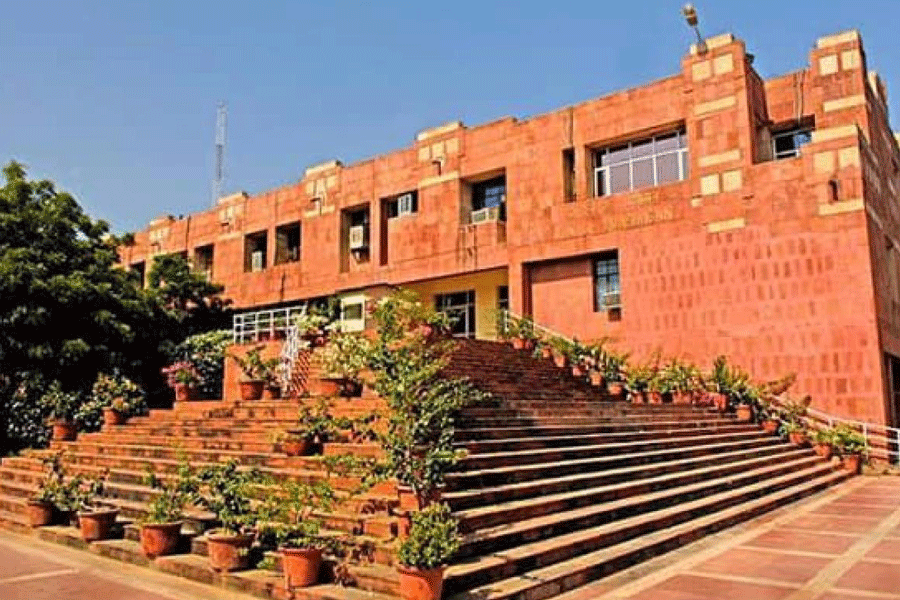
| TOP NOTCH: The main building of Amity Business
School |
Weekly dinner dates with CEOs, mandatory military
training, and feedback from the ?market? to fine-tune classroom lessons. For students
at the Amity Business School (ABS), Noida, exposure to the real world happens
in myriad ways. This privately-funded B-school that has just taken in its tenth
batch of students is located in an eastern suburb of the capital, a 30-minute
drive from Connaught Place, on a particularly attractive campus that, it is said,
even recruiters find impressive.
VITAL
STATISTICS |
WHAT IS IT? A private business management school.
WHO'S THE BOSS? Dr Raj Singh is the deputy director general and head of ABS.
WHAT COURSES? PGDM (150 seats), MBA (380 seats), MBA International Business (240
seats), and BBA (240 seats).
HOW TO GET IN? Through a written test, a group discussion and an interview.
HOW ABOUT JOBS? The school has a track record of 100 per cent placement. Alumni
are scattered across diverse sectors finance, engineering, consumer goods,
information technology. Examples of recruiters are Infosys, HDFC Bank, ICICI Bank,
Microsoft, LG, Samsung, TCS, and Tata Chemicals.
WHERE TO STAY? ABS has hostels for boys and girls, offered to out-of-town students.
HOW CHEAP IS IT? The cost of the two-year postgraduate programme is Rs 4,10,000,
inclusive of the laptop cost. The three-year BBA costs Rs 3,75,000.
GLITTERING ALUMNI: Ritesh Jain, product head, Philips India; Ruchi Pradhan, director,
Interra Software; Sandeep Tiwari, product head, LG Electronics; Akanksha Bhandari,
business analyst, Ernst and Young; Nirupama Jyoti Syan, manager, Microsoft.
WHERE IS IT? ABS, Amity Campus, Sector 44, Noida. 201303. www.amity.edu/abs.
|
ABS now has an annual intake of some 1,000 students
distributed across several postgraduate and undergraduate programmes in business
management. Top school officials say that high flexibility in the choice of specialisation,
constant and intense interaction with the corporate sector and a unique mentoring
programme provide its management programmes distinct features. In addition to
the two-year postgraduate diploma in management and MBA, ABS also offers an MBA
in international business. At the undergraduate level, it offers a BBA and a four-year
integrated BBA+MBA.
The school offers nine core areas of specialisation
in the second-year of the postgraduate programmes: finance, marketing and sales,
information systems, operations management, international business, insurance
and risk management, entrepreneurship, human resources, and customer relationship
management. ?But, even after having picked one core area of specialisation, students
are free to mix and match courses from any of the other eight. This provides high
flexibility and helps students pursue courses across different disciplines,? says
Dr Raj Singh, deputy director general of ABS.
Entrance to postgraduate and undergraduate programmes
is through a written test, followed by a group discussion and an interview. Students
who?ve made it say the interview is far more challenging than the written test.
Once in ABS, each student gets a free laptop (its
cost is included in the fees). The campus is a wireless one and allows students
to access the ABS intranet from their hostel room, school corridors or even on
the lawns outside, looking up class assignments or notes from teachers.
The school lays special emphasis on routine interactions
with CEOs. Each Thursday, a dedicated forum brings CEOs on campus for a formal,
but often freewheeling, discussion on contemporary management practices. And each
Friday, 10 students get to have dinner with a CEO. ?These encounters will help
students observe certain traits and virtues that can?t be taught in classrooms
? vision, an urge to succeed, a style of functioning and dealing with people,?
says Dr Ashok Chauhan, ABS founder-president.
All postgraduate students also have to participate
in an eight-day military camp where they listen to lectures and participate in
exercises. ?It?s designed to instil discipline, leadership, team-action and achieving
specific task with limited resources,? says Singh. ?Each trait will help the students
in the real world. The students also have to study a foreign language ? picking
one from Chinese, French, German, Japanese or Spanish.
?We?ve had 100 per cent placement since the very first
batch of 1995,? says Dr Balvinder Shukla, professor of marketing and head of the
corporate resource centre. ?There has been steady improvement in terms of the
number of offers each student gets and the speed at which the placement process
gets completed.?
G.S. MUDUR
Old memories
Dilpreet Sahi, vice-president, ABN Amro, New
Delhi, recounts his time at Amity Business School
I joined Amity Business School in 1995, in its very
first batch, after a degree in mechanical engineering from the regional engineering
college in Nagpur. I had been selected by two other institutions Mumbais
SP Jain and XLRI in Jamshedpur. But I chose ABS as my parents live near Delhi.
Although it was the schools first year of operations,
we found excellent infrastructure waiting for us from almost the very first day.
An impressive building, a large campus, a well-stocked library with just the right
books and journals, and an excellent faculty.
Nearly 40 per cent of my batchmates had an engineering background. I majored in
marketing, and opted for finance as a minor. We also had to study a foreign language,
which seemed just the right thing to do in the era of globalisation. I picked
German.
Ours was a fun-loving batch and, in addition to academics, I recall playing loads
of cricket in a basement corridor, arranging a fashion show, and organising monthly
dance parties complete with music and DJs. These bashes used to be the
talk of the entire National Capital Region, although they were exclusively for
ABS insiders.
On graduating, I took up an offer from Escorts and
then moved to another engineering company for a while, before I realised that
I was really interested in meeting sales targets. So, I moved to Coca Cola, then
ICICI, and now Im at ABN Amro.
As told to G.S. Mudur
|