|
|
|
Room without a view
|
The relationship between the Manmohan Singh government and the left seems to be entering an uneasy phase. It has not dipped to the extent of threatening the government but everything is not hunky dory either.
There are three tactical reasons why the left supports the Congress-led United Progressive Alliance government: that a secular government at the Centre would help keep the communalists at bay; that some elements of the left?s pro-poor social and economic agenda would be pushed through; and that a stable Centre would in turn bring about stability in the rest of the country.
On each of these counts, the UPA government has given the left cause for worry. Its handling of the Bharatiya Janata Party has been poor. It has done little on the ground to push a pro-poor agenda. And it has mishandled Jammu and Kashmir and Manipur, creating unnecessary instability in the two border states.
However, it is on the handling of communal forces and the non-implementation of the pro-poor policies listed in the common minimum programme that the left is likely to be most upset with the UPA government. There are two tendencies within the Congress about dealing with the communalists. One believes that it is possible to do business with the BJP and the Rashtriya Swayamsevak Sangh; and the other thinks that this is neither feasible nor desirable. To the chagrin of the left, Manmohan Singh, through a series of statements and action, has firmly placed himself in the former camp.
Mani Shankar Aiyar clearly acted in his official capacity in removing the Savarkar plaque from the so-called Freedom Flame. Had he acted in his personal capacity, he would have been arrested for vandalism. However, when given a chance to defend Aiyar at his first press conference, Manmohan Singh thought it expedient (Maharashtra elections were in the offing or so the proximate explanation went) to ?distance? himself from the Savarkar affair. Singh underestimated the intelligence of the people when he reduced the whole episode to the personal predilections of Aiyar.
If Sonia Gandhi had not spoken out forcefully against the BJP at the All India Congress Committee session in New Delhi on August 21, there were indications that some in the Congress were inclined to replace the Savarkar plaque. Aiyar would have been left high and dry by the very party that ritualistically swears by Mahatma Gandhi.
The expediency to sidestep a confrontation with the communalists and appear clever at the same time is also indicated in explaining away the prime minister?s first interview in the country to the RSS mouthpiece, Panchjanya. The left quite rightly believes that it is his allies that Manmohan Singh needs to reassure and not the RSS.
Manmohan Singh may think that ideologically he is neither left nor right. But can a prime minister who survives with the support of the left claim that he is opposed to the ?fundamentalism? of both the left and the right? Will he then not be called upon to explain what the ?fundamentalism? of the left is and what justifies equating it with the communal right in this country? The left also cannot be pleased with the lack of seriousness of the government in professionalizing the bureaucracy. Except the education ministry, there are no indications of any change.
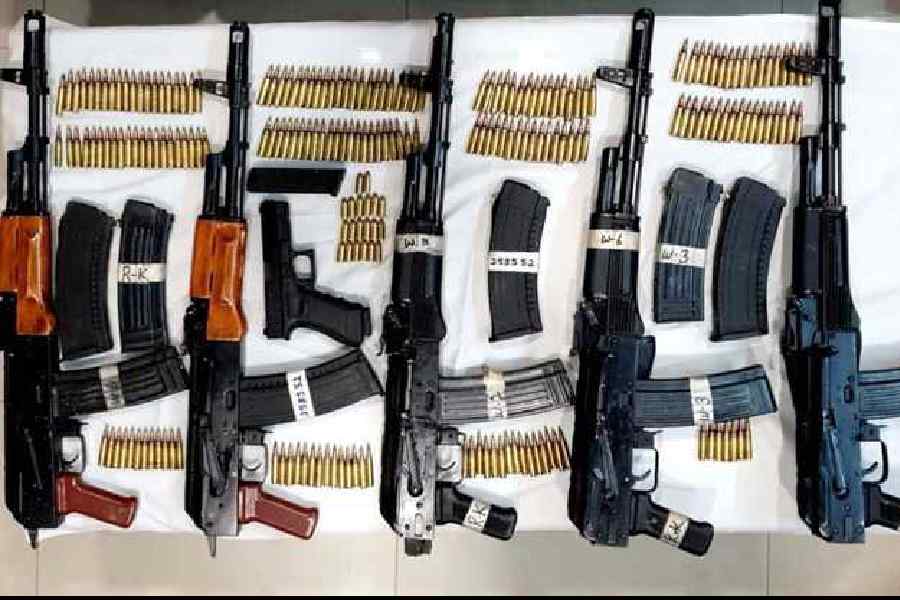
The left?s concern about the deep penetration of the BJP sympathizers into the bureaucracy have also been fuelled by two cases in which the UPA has given a clean chit to the previous government. In both the AK-47 purchase case and the sale of the state-owned Centaur Hotel at Juhu, the junior ministers in charge of the relevant ministries gave a clean chit to the deals in answers to separate un-starred questions placed in parliament. When questioned by the left, the government?s explanation was that junior bureaucrats had prepared the answers without the ministers having had a look! In both cases it was forced to backtrack.
The UPA has also failed the crucial test of its secular credentials in punishing the guilty in the Gujarat riots. The Supreme Court has referred five Gujarat cases to the CBI for investigating and filing chargesheets. The government?s attitude has not only been lackadaisical, it has even allowed a senior police officer from Gujarat under whose charge the riots took place to continue in the number two slot in the CBI.
The left parties have not been successful in pushing their economic agenda either. The left sees the appointment of Montek Singh Ahluwalia as the deputy chairman of the Planning Commission as an affront as he has been opposed to planning all his life. Now Ahluwalia has even overruled their objection to inviting representatives of the World Bank, Asian Development Bank and McKinsey to sit on the commission?s meetings. Till now, the government has largely focussed only on those economic issues that are outside the CMP ? foreign direct investment in telecom, civil aviation and insurance sectors and reducing the interest rate on deposits in employees? provident fund. The left has been forced to engage the government on these issues rather than pushing it to implement the employment guarantee scheme, the promised food for work programme and education for all. Even after three months in office, the UPA government has not moved on any substantive issues of the CMP. Only a day before his departure to New York did Manmohan Singh make a few populist announcements and give some assurances to the left. The implementation of the assurances, which are general in nature, is yet to be judged.
A perception has, therefore, gained ground that the Congress is taking the left for granted, the dominant belief being that it cannot destabilize the government for fear of the BJP coming back. But the left also has its constituency to safeguard. If there is nothing being done to protect their interests, why should it always be accommodative of the UPA?
Some in the left are already arguing that neither Manmohan Singh nor the Congress has understood the mandate that catapulted them unexpectedly into power. Otherwise, they claim, the UPA ministers would not go on harping about ?continuity? in policies.
A government may be in continuity, but not the policies of the political formations that head them, the left parties argue. There is more than a germ of truth in that. If the people of India had wanted a continuity of policies they would have voted the Vajpayee government back. Why would they send a complicated mandate that allowed the Congress to form this government? The fact remains that the people, especially in the rural areas, have voted for change because the policies of the previous government either did not address their concerns or directly hurt them. This is something that the left seems to understand better than the Congress. And unless something is done urgently to address the issues of the poor, there is bound to be further trouble ahead in the relationship between the Congress and the left.
|