|
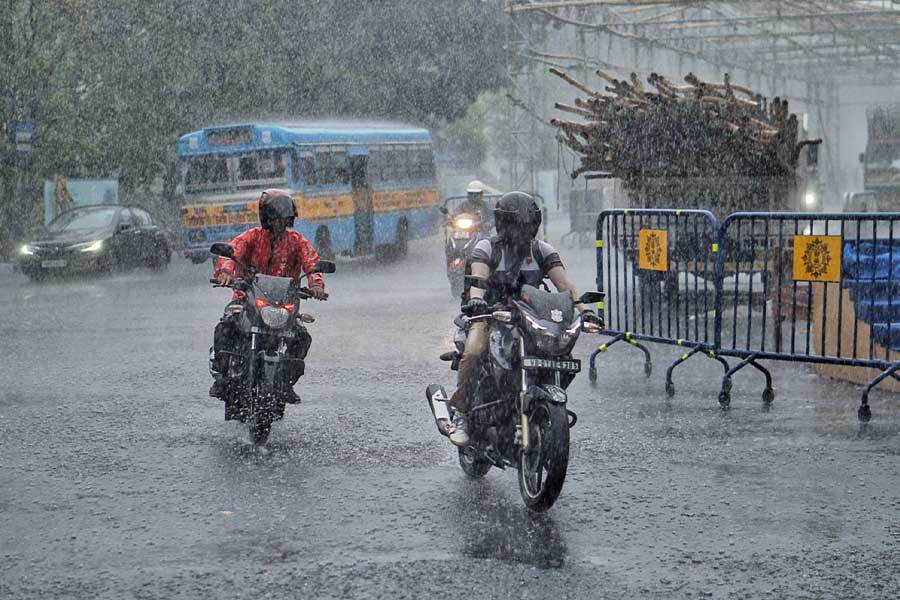
Going by the rain gods, it looks as if 2004-05 will
be a difficult year. The meteorological department’s figures for June 1 to July
21, 2004 show that 19 of the 36 meteorological zones have had “deficient” rainfall.
Statistically, it means that precipitation in these regions has been anything
between 20 per cent to 59 per cent less than the normal for the time of the year.
One might argue that it is still not as bad as the
drought of 2002-03 when, by late July, 22 zones suffered from deficient or “scanty”
rain (which is 60 per cent to 99 per cent less rain than normal). Nevertheless,
it is serious enough. As it stands today, this year seems to be witnessing the
second worst monsoon in the last six. Certainly, the first half of the season
has been a disaster.
Almost all major agricultural, vegetable and fruit
producing regions have been badly hit. Western Uttar Pradesh has had 43 per cent
less rain than normal; Haryana 50 per cent less; Punjab 40 per cent; Himachal
Pradesh has a shortfall of 50 per cent; the oilseed zone of western Madhya Pradesh
is down by 47 per cent; and Gujarat has had 42 per cent less rain than usual.
Rainfall in Rajasthan has fallen short by 50 per cent, and we could well be seeing
yet another severe drought in the state — its second in three years. Another desperately
poor area, eastern Madhya Pradesh, has had 19 per cent less rain. There are also
strong chances of drought in most parts of Maharashtra, Telengana, Karnataka,
Saurashtra, Kutch and districts of Kerala.
Moreover, certain regions have been inundated by excess
rain. Bihar, for instance, has been ravaged by floods. While Laloo Prasad Yadav
has exhorted us to wait till the floods recede and then see how the new silt increases
agricultural output, the fact is that parts of Bihar and Assam have been badly
affected.
Although it is too early to make a definite call,
I would guess that agricultural output in 2004-05 will be 2 per cent less than
what it was in 2003-04. I hope that I’m wrong on this. But if it comes to pass,
agriculture’s contribution to GDP growth will be negative — somewhere around -0.5
percentage points. In such a scenario, industrial sector growth will not be much
more than 6.5 per cent, and its input to GDP growth will be 1.75 percentage points.
Even if the service sector were to grow at 8 per cent — which would add 4 percentage
points to GDP — we may not be looking at much more than 5.3 per cent GDP growth
in 2004-05. That would be a far cry from the 8.2 per cent achieved in 2003-04.
That brings me to the issue of a long-term failure
of governance. No large continental country like India with a national income
of over $540 billion is so crucially dependent upon monsoons. Our enslavement
to rain might have been acceptable from independence up to the late Sixties. After
all, we were an abjectly poor country when we got our freedom, and one could therefore
give the Central and state governments a grace period of over two decades to get
the irrigation systems right.
Unfortunately, our record on major, medium and minor
irrigation has been pathetic. In 1950-51, the share of cultivated area under irrigation
was 17 per cent. It took two decades for this to grow to 23 per cent in 1969-70.
Between the beginning of the Seventies and now, it has grown to 40 per cent. Thus,
for the country as a whole, the share of irrigated area has grown by 23 per cent
points in 50 years — at an average rate that is well below half a per cent per
year. Only 38 per cent of the cropped area in Gujarat is supposed to be irrigated;
for Madhya Pradesh it is 27 per cent; for Karnataka 26 per cent; and in Maharashtra,
it is a mere 17 per cent.
Even these numbers are suspect. Anyone familiar with
agriculture will vouch that many minor and medium irrigation canals exist only
on paper. These worked at some point of time; but years of neglect and silting
have rendered them quite useless. Besides, most tubewells don’t work the way they
should because of the lack of electricity and a significant decrease in the water
tables. However, they remain in the official statistics. A more accurate estimate
of properly irrigated area would be around 33 per cent of gross sown area. So,
57 years after independence, two-thirds of the cultivated area of this country
still depends upon the vicissitudes of rain.
This sad state of affairs is entirely a function of
poor governance. For decades, state governments have spent increasingly vast amounts
of money on paying salaries to their bloated bureaucracies at the expense of irrigation
and power — the two critical ingredients for consistently successful agriculture.
Indeed, the classic conundrum of good governance is that the states which are
the poorest often have the worst governance. If you don’t believe that, look at
Bihar under Laloo and then Rabri Devi. Other than progressively bankrupting the
state, their claim to fame is that they have made someone like Karpoori Thakur
look like a great chief minister. Also, en passant, look at the governance
of Uttar Pradesh under Mulayam, Mayavati, Kalyan Singh and the rest of their ilk,
and you will know what I mean.
The political and economic ramifications are quite
frightening. Some time ago, my friend Jairam Ramesh coined a term called “EOK”
or “East of Kanpur”. According to Jairam, you could cut a longitude through Kanpur
and safely claim that the states lying to its east were significantly worse off
than those lying to its west. This is so true. On the one hand we have Maharashtra,
Gujarat, Karnataka, Tamil Nadu, parts of Andhra Pradesh, Delhi, Haryana and Punjab,
which are prospering and growing with every passing year. On the other, we have
desperately poor states like Orissa, mineral rich but utterly backward ones like
Jharkhand and Chhattisgarh, an obnoxiously governed tragedy called Bihar, the
badlands of eastern Uttar Pradesh, a state like West Bengal which just can’t seem
to do the structural transformations necessary for rapid growth, and the neglected
swathe of the North-east.
What we are witnessing is the emergence of two distinct
Indias: one that is growing, attracting investments and promising greater hope,
versus another in which the citizens cannot look forward to having a better life.
With every passing year, the gap widens.
This can’t be a sustainable pattern of development
for the nation and is a serious threat to the country’s unity and polity. One
can claim all manner of “historical” reasons for such sharply differentiated performance,
but the bottom line is the quality of governance. In a country which does not
have the best in class governance, the states that did somewhat better have been
rewarded by higher growth; and those that needed to be governed the best weren’t
governed at all. In theory, you can have good governance in poor states. But when
you see Laloo, Rabri Devi, Uma Bharti or Mulayam, you realize that praxis is different.
|