TT Epaper LHS
The Telegraph
TT Mobile
 
 
IN TODAY'S PAPER
CITY NEWSLINES
 
 
ARCHIVES
Since 1st March, 1999
 
THE TELEGRAPH
 
CIMA Gallary
 
Email This Page
AN UNEQUAL LIFE

The Golden Temple has monopolized Amritsar’s scene since the day the fourth Guru, Ram Das, had its foundations laid over four hundred years ago and named it Harimandir — the temple of God. It was first known after its founder, Ram Das Pur. It changed its name to the waters which surround the central edifice re-created in marble and gold leaf by Maharajah Ranjit Singh to Amritsar, the pool of nectar. The dip in the holy waters cleanses you of your sins committed earlier: Amritsar Sarovar nehtey sab utray paap kamaatey. It is also known as Sift daa ghar — the house of praise.

One tends to forget that Amritsar has numerous other temples including the Hindus’Durgiana, remnants of a fort, Company Bagh, Jallianwala Bagh and, above all, its people known after the colloquial umberseri as umbersarias — a garrulous, money-minded people living in narrow, foul-smearing lanes that wind through the city’s belly like intestines. Those who made it big live outside the city in large bungalows amidst spacious gardens.

The city, mainly the Harimandir have been much-photographed and painted on canvas. For the first time, its people have been captured by a young umbersarni, Rupa Bajwa, in her debut novel, The Sari Shop. It is based on men employed in the Sewak Sari House to which come wives and daughters of the rich and the not-so-rich to buy the best that is made in the country. The main character in the novel is Ramchand, a semi-literate, callow youth trying to teach himself English while he ogles at the wife of his landlord washing clothes and utensils in the courtyard below the window of his one-roomed lodging.

One of his assignments takes him to the bungalows of the rich Guptas and Kapoors. Both familys’ earlier venture had flopped and they did not pay their workers wages for three months. Even after they made good, they did not bother to clear their debts to the workers. One among them, Chander, who was rendered destitute found a job with Sewak Sari House. He drowned his past grievances in copious libations of hard liquor. His wife was not so forgiving. First, she appeared at the gates of Gupta’s mansion and cursed them in choicest Punjabi abuse till she was taken away by the police. Undaunted, she repeated the performance outside Kapoor’s mansion. This time the police took her, gang-raped her and dumped her in her hovel. Worse was to follow. Chander and his wife got drunk, fought each other and created riot in their mohalla. The people came, savaged Chander’s wife thrusting lathis in her vagina then setting her hovel and her ablaze. Ramchand was the only one who knew the truth.

He exploded with anger against injustice in the world, stormed into Sewak Sari Shop, abused his colleagues and his boss. He went without food for many days. When his anger subsided, he meekly returned to his shop, apologized to everyone. He was forgiven and got back his job. The moral, if you call it one, is that it is wise for the poor to accept injustice with good grace. The unjust rich have the law and the police on their side.

Rupa Bajwa is blessed with a gift for words and the craftsmanship required to write a highly readable novel. I have little doubt she will make a name for herself in the years to come and add lustre to the name of the holy city.

Great leveller

“We are not afraid of death but of dying.” This was the opening sentence of an article written on the subject in Gurmukhi. It had been cyclostyled and delivered to me by Manmohan Singh Sabharwal and Gagandeep Singh of Patiala. On an earlier visit, I had told them that I was compiling a collection of obituaries I had written and writing one of myself entitled Death At My Door. They thought I should have a look at the article they had brought.

I found the article very illuminating and give a gist of it for the benefit of my readers. After asserting that we are more afraid of dying than of death, the author goes on to say that there is only one way we are born but hundreds and millions of ways we die. The dead far outnumber the living. We try all kinds of medicines to cure us of illnesses whereas death is the final cure of all that ails our bodies. Death is the ultimate in democracy as it comes to everyone, the rich as well as the poor. No one can argue with it or persuade it to change its mind...

Life is short. What is more important than how long you live is how you live the life given to you.

The main concern of all world’s religions is death: how to overcome the fear of dying. We coin words to lessen its impact: gone to his heavenly abode, passed away, marched on, became beloved of God, ended life’s journey and so on. We have different customs to distance ourselves from the dead: some bury them, some cremate them. We have periods of mourning and we hold prayers on their death anniversaries. The most important thing to keep in mind while performing rituals for the dead is that you too must die — memento mori.

People of different ages have different perceptions of death. Children do not understand it beyond thinking that the dead person has gone to some other place. In youth they think it is still a long way away. It is only in their forties that they seriously contemplate about death and wonder if they will have enough time to complete tasks they have undertaken. In their seventies, the possibility of impending death becomes a reality. As long as one has grand parents and parents, one does not think he also will die. It is after they are gone that a person realizes that his turn to go will be next.

Death is the basic element we all fear. We play hide and seek with it. It is better to confront it boldly. Don’t count the years you have lived, but what you put in the years you lived.

For the people?

How wonderful is our democracy!

In form it is foreign, in spirit it is desi.

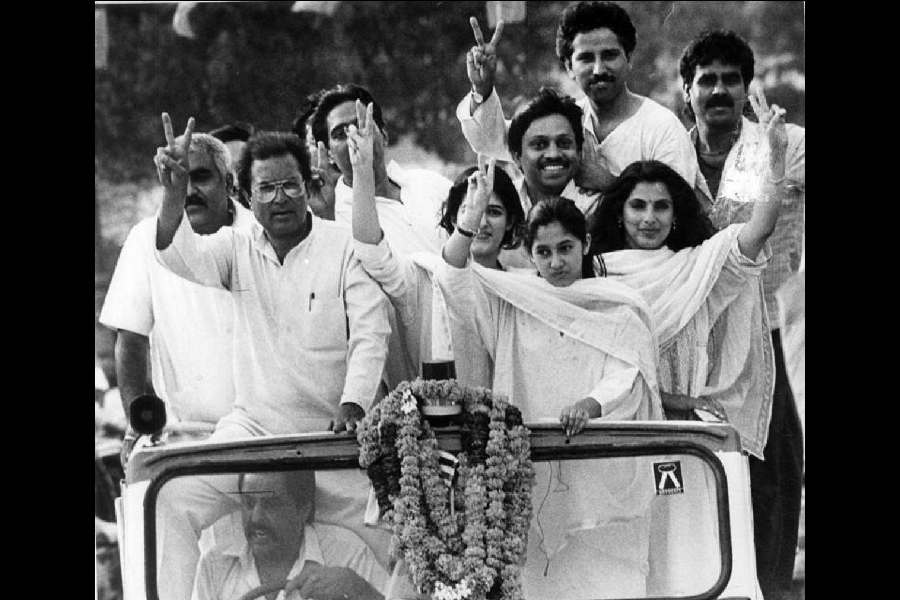
We fight elections like soldiers unskilled

Many are injured, some are even killed.

Parties issue manifestoes which nobody reads.

The path they chalk out one rarely treads.

Since nobody listens to political blokes

They hire stars to attract the folks!

Some distribute sarees among women voters

Others offer free milk and laddoos to their supporters!

Candidates coax their voters in many ways

The tamasha goes on for several days,

In between, come exit polls, off the mark

Instead of enlightening, they keep us in the dark.

Winners rejoice when over is the race

But losers seldom accept defeat with a grace!

(Courtesy: G.C. Bhandari, Meerut)

Top
Email This Page