|
|
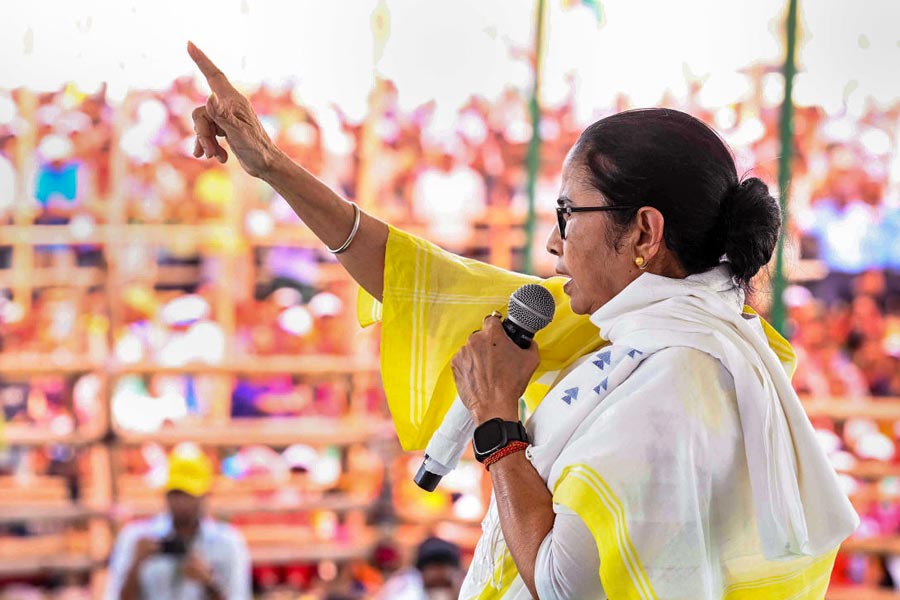
Amal Allana in the city. Picture by Aranya Sen
|
Born to an Arab father and a Gujarati mother, Delhi-based theatre veteran Amal Allana admits being haunted by the question of a cultural identity all her life. She also admits being aware of her post-colonial experience, and so theatre has largely been an attempt to understand her place and her position.
As the only female speaker on the five-member panel discussing globalisation of Indian theatre at the Odeon 2004 seminar last week, Allana steered the talk to a close study of how she has created her own idiom through performance, while drawing from global sources.
“Contemporary theatre is my reality,” she says. “I do not belong to any particular tradition. I found the jatra and tamasha inspiring, but I knew I had to create a language of my own.”
Almost as a reflection of her personal quest of an identity, Allana visualises Gabriel Garcia Marquez’ Erendira as composed of multiple selves.
The spectacular production, staged by Television and Theatre Associates at Odeon 2004, had around six women of various ages playing Erendira and her grandmother.
“Erendira celebrates hybridity,” says Allana, among the most sought-after theatre personalities around and one of the real stars at the Hutch-sponsored theatre fest in town.
To retain the sense of desert and bleakness, she sets the Latin American fable in Rajasthan.
“I was faced with the problem of capturing the quality of strangeness in Marquez’ work while retaining the Latin American flavour. Choreography was a vital part. So we incorporated flamenco and also Columbian music,” explains Allana, the creator of around 40 stage productions with her troupe Television and Theatre Associates since 1985.
Of these, King Lear, Himmat Mai, Nagamandal and Begum Barve have especially been lapped up by theatre-goers across the country. For the past 10 years or so, Allana has focussed on women, producing plays such as Sonata, Char Chougi and Erendira.
After graduating from National School of Drama (NSD), Allana studied drama for two years in Germany and followed it up with a long stay in Japan, where she learnt the Noh and Kabuki forms.
“Movement is an integral part of my drama, and I have studied kathakali, kudiayattam and other dance forms alongside,” she adds.
In the pipeline is a project — still in the nascent stage — on the Mahabharata, for which Allana plans to use the martial art form of kalaripayattu to highlight the theme of war.
On the agenda is a comedy, too, where she would adapt a short story by late painter Bhupen Khakkar.
“But I have consciously chosen Hindi as my language to reach out to a larger audience. I cater to a niche audience and I am happy with that,” sums up Allana.
|