|
In 2002-03, a major survey was conducted on investment
climate and the competitiveness of Indian manufacturing. Of the 250-odd detailed
questions in this all-India survey, a dozen were purely qualitative in nature.
More than 1,850 factory managers and entrepreneurs were asked to rank 12 states
of India according to their perceptions of best and worst investment climate.
They were also asked to rank each of these states in terms of whether it was better
or worse than the state in which their factory was located. Finally, they were
asked to rank states by various constituents of investment climate, such as labour
relations, power supply, law and order, hassles by local government, telecommunication
facilities and the quality of transport infrastructure. The idea was to check
the quality of their rankings — namely, how well did these stand up in the face
of “hard” data from the survey as well as secondary sources.
Maharashtra scored the highest in terms of investment
climate, followed by the national capital region of Delhi. These two states were
considered to have the “best” investment climate. Next in rank was a cluster consisting
of Gujarat, Andhra Pradesh and Karnataka, which were classified as having”good”
investment climate. Punjab, Tamil Nadu and Haryana were in the category of states
having “medium” investment climate.
Madhya Pradesh, Kerala, West Bengal and Uttar Pradesh
were at the bottom of the pack, and were considered by entrepreneurs and factory
managers to exhibit a “poor” investment climate. To be considered a marginally
better investment destination than Uttar Pradesh can hardly be perceived as the
crowning glory of West Bengal.
This was the second survey of its kind, coming on
the heels of a previous one conducted in 1999-2000. In both instances, West Bengal
was relegated to the bottom category. For a Bengali, albeit in exile, I was depressed
by the results — for it showed that, despite positive changes that have occurred
in the last five years, Indian manufacturing industry’s perception of West Bengal
remains as dismal as before.
Consider some of the data in greater detail. While
21 per cent of the respondents believed that West Bengal was a better investment
climate state compared to the one in which they had their manufacturing plant,
79 per cent thought it to be worse. Similarly, West Bengal was considered by entrepreneurs
and managers to fare poorly in labour relations, law and order, hassles by local
government officials, transport infrastructure and power supply.
As the “hard” data showed, some of these perceptions
were wrong. Take factory visits by government officials as an example. Managers
of plants in West Bengal were graced, on average, with 8.5 visits of government
officials per year. This happens to be well below the average of 13.2 visits in
Tamil Nadu, 12.4 in Gujarat and 10.5 in Andhra Pradesh, and less than the overall
12-state average of 8.9 visits.
Equally, West Bengal was far better on the power front
than what perceptions suggested. It had significantly fewer power outages per
month compared to most states. That the power situation was better also showed
up in the fact that 55 per cent of factories in West Bengal had captive generator
sets, compared to 66 per cent in Karnataka, 74 per cent in Andhra Pradesh, 91
per cent in Delhi’s national capital region, and 92 per cent in Punjab —states
that were ranked well ahead of West Bengal in the subjective view of investment
climate.
Similarly, the average cost of power — after taking
into account power drawn from the public grid and private generator sets — was
Rs 4.10 per Kwh for West Bengal, versus Rs 4.50 for Andhra and Karnataka,Rs
5 for Gujarat and Tamil Nadu, Rs 5.90 for Punjab and Haryana and Rs 6.30 for Delhi
and its neighbourhoods.
So, while in some areas, the data showed that West
Bengal was clearly better than the average, the fact was that perceptions showed
otherwise. The overwhelming view of entrepreneurs and manufacturers was that West
Bengal was no better than Uttar Pradesh, Kerala or Madhya Pradesh in terms of
its investment climate. What that meant was that, given a choice, a manufacturing
company would rather invest in Maharashtra, the Delhi region, Gujarat, Andhra
Pradesh, Karnataka, Tamil Nadu, Punjab and Haryana than in West Bengal.
Since perceptions matter a great deal in making investment
decisions — especially those that involve the outlay of several hundred crores
of rupees — the powers that be in West Bengal clearly have their task cut out
for them. For the rest of this piece, I would like to suggest a few ideas to gradually
reverse these opinions and attract serious interest in the state.
First, the salvation of West Bengal no longer lies
in big manufacturing. To be sure, Haldia Petrochemicals is something to be proud
of, and Purnendu Chatterjee may well be thinking of adding a new plant, but large
scale metal bashing and petrochemicals is probably not the state’s forte.
Had engineering and metallurgy been West Bengal’s comparative advantage — as it
had up to the mid-Sixties — there would have been many buyers for the languishing
factories that dot Hide Road, Taratolla, Durgapur and Asansol. There aren’t.
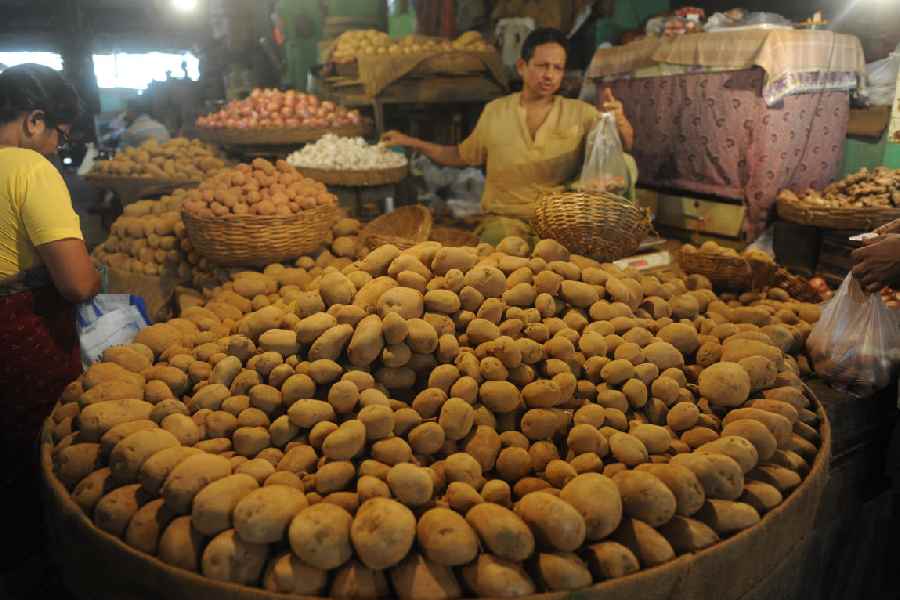
Second, vegetables and fruits are, most definitely,
the state’s strong suit. Without doubt, West Bengal enjoys one of highest productivity
in the growing of vegetables — which are available in abundance throughout the
year. Equally, the soil and climate of many parts of the state are excellently
suited for growing certain types of fruits. What the state badly needs is a couple
of major fast moving consumer goods companies to invest in vegetable and fruit
processing. Given the important role of panchayats in rural Bengal, the
model may require taking a leaf out of Amul — by moulding the best cooperative
practices with a clearly defined corporate purchasing, branding, marketing and
sales set up. The advantages are many: plentiful supply of raw materials, good
power supply to support the setting up of a series of cold storage chains, and
a modern port at Haldia.
Properly done, I can see West Bengal being a significant
exporter of processed food and preserved fruits to southeast Asia as well as west
Asia. The state has to persuade companies like Hindustan Lever, Britannia, ITC
and major international packaged food players to examine the prospects and invest.
They may demand many concessions. I would accede to them in order to bring in
the investments.
Third, the state should really focus on getting a
bigger proportion of the information technology and knowledge industry business.
While youth passing from the Indian Institute of Technology, Kharagpur, Shibpur
and the Regional Engineering Colleges are finding entry-level jobs in IT companies
in Bangalore, Hyderabad, Chennai and Pune, there are hardly any serious IT facilities
or development centres in West Bengal.
Just as Azim Premji was persuaded to set up a Wipro
Development Centre in Calcutta, so too should others be won over to invest in
West Bengal. Cite lower cost of living; better quality of life, telephone facilities,
lack of power cuts, give dollops of concession, and get more IT and business process
outsourcing investments in the state.
Perceptions change for the better when more and more
people speak well of something. Industrialists in Calcutta singing paeans of praise
for the state doesn’t count for much. West Bengal needs industrialists elsewhere
singing Hosannahs. That’s when the next Renaissance could happen.
|