|
|
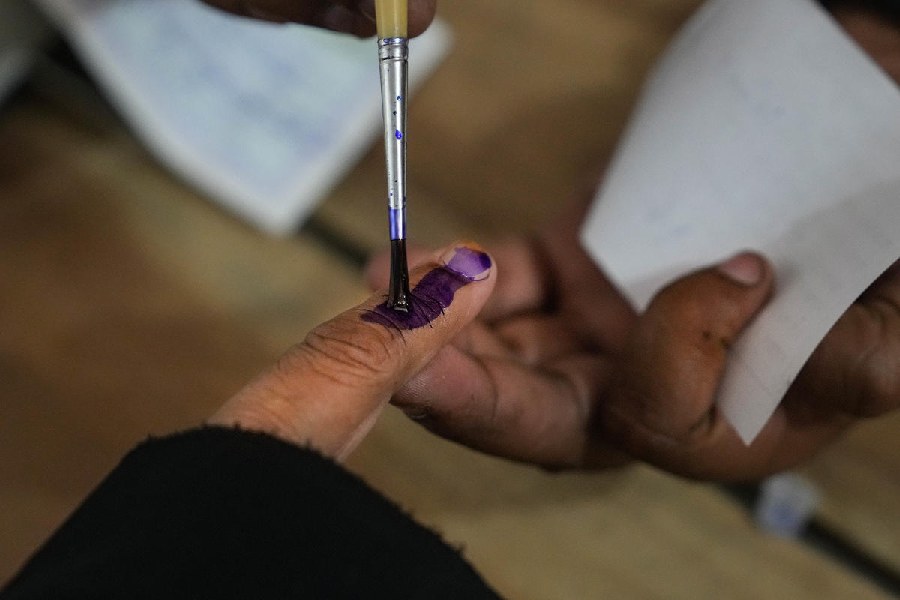
A Hungarian woman casts her vote in a polling booth in Budapest while her dog Narcis yawns. (AFP)
|
Brussels, June 14 (Agencies): European voters punished leaders in Britain, the Netherlands, and to some degree Italy for getting involved in Iraq, but also turned their ire on German chancellor Gerhard Schroeder and French President Jacques Chirac, Europe’s leading opponents of the war, vote tallies showed today.
As counting in the biggest transnational election in history neared a finish, the scale of public alienation highlighted challenges facing EU leaders when they meet later this week to try to finalise a first constitution for the bloc.
“Across Europe we have seen sitting governments receive significant protest votes against them,” British foreign secretary Jack Straw said before starting a final round of pre-summit constitution negotiations in Luxembourg. “One clear message is that voters across Europe, including in the United Kingdom, want a European Union (EU) that works better in their interests. That’s the purpose of the draft constitutional treaty,” he said.
But the huge protest vote against British Prime Minister Tony Blair's Labour Party, and gains for Eurosceptics in Poland, the Czech Republic and Sweden, raised doubts about whether the new charter will ever be ratified. Britain is fighting to preserve national vetoes in core areas while Poland, the biggest of 10 new members, is resisting a change in the EU voting system that would diminish its power.
A mere 45.3 per cent of nearly 350 million eligible voters bothered to cast ballots in the four-day exercise in cross-border democracy, the lowest turnout since direct elections for the Strasbourg-based assembly began in 1979. The most startling figure was that participation in the EU’s 10 new, mainly ex-communist east European member states was just 26 per cent.
The European Commission said the main reason was that the European Parliament had too little power, while Estonian foreign minister Kristiina Ojuland said it showed that neither old nor new EU citizens understood the legislature’s growing role. For some, the low poll could undermine the assembly’s legitimacy. “Of course I would have appreciated it very much if we had a stronger legitimation of parliament,” German foreign minister Joschka Fischer lamented.
British voters punished Blair for his role in the US-led Iraq war and governing parties in France, Germany and Poland for economic stagnation, unemployment and painful social reforms.
Only the recently elected Spanish and Greek governments escaped public wrath, amplifying their recent national victories, as did Slovakia’s centre-right coalition on a pitiful 17 per cent turnout — the lowest in the 25-nation bloc.
Britain and Poland sent strident new voices of hostility to European integration to the EU legislature. The UK Independence Party, which won its first three seats in 1999, grabbed 12 this time, while Opposition parties in Poland, including the populist Self Defence and the League of Catholic Families, beat the Socialists into fourth place.
|