|
One question that has been raised in the wake of the
recent election results is whether democracy and development are compatible with
one another. This has been voiced in the media by television anchors as well as
commentators. This issue and the subsequent developments in financial markets
have helped public attention to focus on two things. The first is the power of
volatile finance. Foreign institutional investors who come for portfolio investments
and powerful brokers can mould market sentiments with a telling decisiveness.
The market, according to analysts, understands only greed and fear. The second
issue is of course the synonymous use of the terms “economic reforms” and “economic
development”.
“Economic reforms” is understood, at least in terms
of current priorities of the market’s sentiments, as being exclusively about privatization
of public sector units and changes in labour laws where the hiring and firing
of labour will be made more easy. The sensitive index becomes the exclusive marker
of prosperity, its upward mobility the primary index of national well-being. This
is somewhat ominous. If democracy throws up a government with a mandate that may
assign a low- er priority to the speculative health of financial asset markets,
then democracy and the mandate are put under the scanner, not the design of economic
reforms as understood by those who live by greed alone.
The crux of a market-friendly economic strategy is
to provide enabling environments for markets to function. Such markets would certainly
include those for financial resources as well as those for labour services. However,
markets do not guarantee equitable outcomes in terms of incomes, profits earned,
wealth accumulated. The poor are disadvantaged because their ability to access
markets is limited. In exactly the same line of argument, the rich (those who
already possess more resources) have a distinct advantage. In markets, as any
elementary American textbook will highlight, people vote with their dollars. And
markets are amoral in the sense that if a brand of shoes is selling well, no one
cares if the killer or the killed wore them on the streets during a communal carnage.
Political democracy is more egalitarian where universal
adult franchise grants one vote to each, irrespective of wealth. The wealthy may
certainly have more voice and influence in the making of political affairs, but
the economically disenfranchised still have a political vote, which in India has
been often used to register their opinion on the nation’s state of affairs with
quite unambiguous political messages.
The verdict of the elections has left many people
in shock and disbelief. Political analysis of the verdict is as difficult as gauging
the accuracy of exit polls and opinion polls. India is too large and complex to
provide an easy general answer. Clearly, myriad local factors would be of concern
to the voter. However, it would be unwise to attribute the verdict entirely to
local factors, and hence come up with the conclusion that aggregate numbers have
no meaning in a heterogeneous, fractured polity. Indian democracy does have local
roots, but is also tall enough to look at the nation as a whole. The overbearing
arrogance of a pseudo-cultural nationalism with consequences like the Gujarat
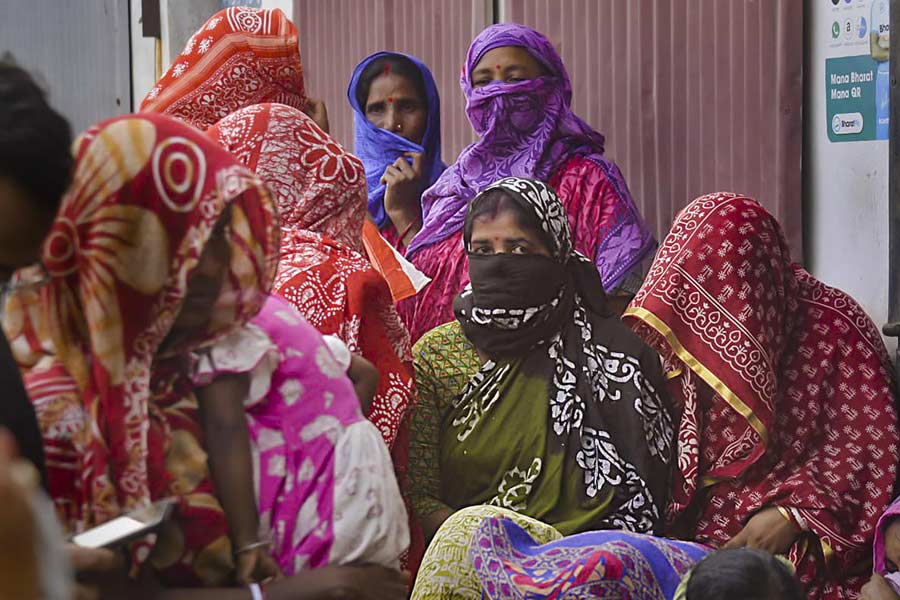
riots and a rewriting of national history, and the desperate poverty that is revealed
when women die in a stampede for the cheapest sari, do not go unnoticed
by the silent majority that never got the chance to shine.
In the light of the experience of the past dozen years,
some central issues of economic policy have come to the fore. In the decade of
the Nineties, all three major political formations, namely the Congress, the Third
Force and the Bharatiya Janata Party-led National Democratic Alliance had had
stints in government in New Delhi. None of them has openly, and in sweeping terms,
decried a market-friendly economic policy stance. For sure, there have been differences.
Privatization, certain important aspects of fiscal and monetary policy, labour
market reforms, are just a few issues that have been debated not merely across
parties but within political formations as well. The specific role of the World
Bank, the consequences of the International Monetary Fund’s prescriptions, or
the skewed architecture of power in the World Trade Organization are all of concern
for the simple reason that a number of implications go against the perceived notions
of national interest and power. There are a number of other consequences that
go against the economic interests of the poor and economically deprived, cutting
across national borders of developing, low income nations. What then have we learnt
from the experience of the past dozen years? Some people are raising the more
ominous question — are democracy with universal franchise, and market-based development
policies irreconcilable?
The onus is on the Congress and its allies, especially
the left, that such reconciliation is possible, necessary and worthwhile. This
is all about reforms with a human face. On a very rough and ready count, if we
look at the income distribution in India, then we can distinguish three broad
groups. First, consider the top 20 per cent. Come democratic socialism and “garibi
hatao” or market-friendly globalization, they know how to work the system,
for the simple reason that they run the system. The bottom 40 per cent suffers
from acute poverty and extremely poor social opportunities for mobility, security
and human dignity. This group would require a lot of direct intervention and planning,
in ensuring that they lead a decent life. There is also a large 40 per cent in
the middle that is not desperately poor, but suffers from lack of opportunities
to work the economic system and grow with it.
The new government can easily work on a minimum programme
focused on the bottom 80 per cent. The top 20 per cent can take good care of themselves.
A social sector and infrastructure investment programme could be carried out with
tenacity and urgency. A credible stance would require not allowing anything to
come in the way, not organized labour unions, nor vested political interests,
and certainly not the handful of brokers and market-makers of Dalal Street. This
would automatically create an attractive investment climate for real, as opposed
to purely speculative, investments.
If this programme implies that hedge funds desert
Dalal Street, so be it. If this implies that privatization of profitable PSUs
is scrapped, so be it. If this implies stalling labour-market reforms without
a proper social safety net in position, so be it. It is unlikely that the Fund-Bank
would be terribly upset. It is unlikely that our foreign policy would be jeopardized.
It is likely that we will succeed in creating economic and social opportunities
that blossom from the soil.
Congress and the left parties face the challenge of
the century in terms of their ability to govern. Can they pull it off, or would
they also succumb to the arrogance of power? They have united on a common social-political
agenda of stopping the onslaught of religious fascism. But to sustain the resistance
they will have to mix their political memories and economic desires really well
to breed lilacs out of a wasteland of greed and fanaticism.
|