|
|
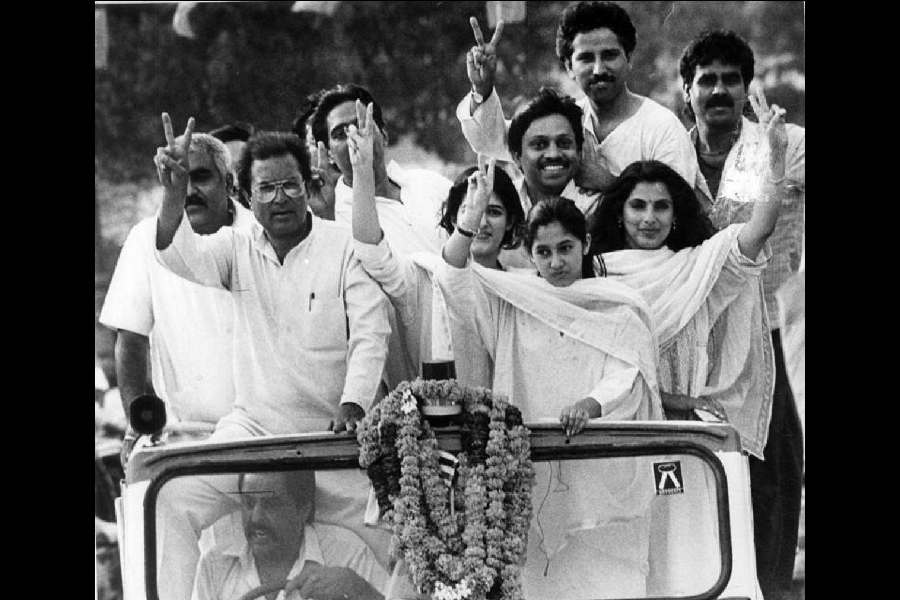
Raj Babbar with Samajwadi Party leader Amar Singh in Delhi. (PTI file picture)
|
Agra, May 4: In 1999, it was Raj Babbar versus a question mark, to parrot a BJP-patented phrase.
Outgoing MP Bhagwan Shankar Rawat of the BJP was then up against a tidal wave of anti-incumbency because people felt he won from Agra thrice without doing much. But they also conceded Rawat could have sneaked past because of the BJP’s impregnable base in the nearly 4-lakh-strong trading community.
Filmstar Babbar, fielded by the Samajwadi Party, upset Rawat’s apple cart. Suddenly, the BJP veteran was thrown out of the fray as Brahmins, Banias, Kayasthas, backward castes, Muslims and even Jatavs — the Bahujan Samaj Party’s backbone — submerged their sectional interests in the Babbar cause and cheered him all the way to the hustings.
Babbar won the election by a margin of 1.15 lakh, but his victory was unique in that the Samajwadi Party and its chief, Mulayam Singh Yadav, were secondary and his persona central to it.
Five years down the road, the hero who, ironically, is also remembered as the rapist in Insaaf ka Tarazu, is slogging under the anti-incumbency burden like most sitting MPs.
Agra is plastered with his posters but they tell a deeper story because every portrait of Babbar vies for space with those of five or six others supposed to be his cheerleaders. These cheerleaders have become his bane because the Samajwadi Party accuses Babbar of creating his own network of clients and interest groups, independent of the party.
“He has alienated grassroots workers,” says Shahrukh Siar, a local party leader. Siar alleges that Babbar’s “power parasites” — who are “living in 100 per cent AC comfort” — are lounging in his air-conditioned election office while the cadre is doing the “real hard work”. Siar claims “the workers’ hearts are not really in the campaign”.
Because Babbar had fuelled the city’s civic and economic aspirations like few elected representatives had, he has been put in the dock, as it were.
A hoarding, sponsored by the Jagrut Mathadata Manch, posed the following questions:
Why were you silent on the lootings and killings that took place in Agra?
What did you do to help the Jatavs who lost their lives in a communal riot last year?
Why didn’t you pressure the police to arrest the killers though your party is in power?
How many days a year were you around to listen to people’s problems?
Why are you deceiving people by residing permanently in Mumbai and not Agra?
Neither the BSP nor the BJP associate themselves with this hoarding. BSP candidate Keshav Dixit is embarrassed by the reference to the Jatavs because the riot in question involved Muslims and the party is busy courting them.
“I have not mentioned it in my campaign,” he says, adding that his thrust is on development. “The issues are providing drinking water and power, things Babbar never bothered about because he is a non-resident MP.”
The BJP, which jettisoned Rawat for a new face in businessman Murari Lal Mittal Fatehpuria, is too busy consolidating its base vote to fine-tune an anti-Babbar campaign. Its Brahmin votes are being spirited away by the BSP, while the Banias were hedging their bets between the BJP and the Samajwadi Party, despite Babbar.
“Mulayam Singh has done traders a lot of good so we’ll vote for him,” says transporter B.M. Singh.
The key to Babbar’s return is Mulayam Singh. The chief minister has addressed several meetings in the rural and urban pockets and even sought pardon on behalf of his candidate.
In these meetings, Babbar says little and allows his boss to make the promises.
Primary among these is, if re-elected, he will spend 70 per cent of his MPs Local Area Development fund on the villages in Agra and 30 per cent in the city. Of course, Mulayam Singh assures his supporters that Babbar will spend more time in Agra than Mumbai.
If Babbar does win, he will have only Mulayam to thank.
|