TT Epaper
The Telegraph
TT Photogallery
 
 
IN TODAY'S PAPER
CITY NEWSLINES
 
 
ARCHIVES
Since 1st March, 1999
 
THE TELEGRAPH
 
CIMA Gallary
 
Email This Page
City Lights
Fitness chant for champs

In town and not training with Anwar Wahab? That’s a no-no for Arjun Atwal. Since 2001, the ace golfer has been keenly following the power-lifting regimen the ace fitness adviser has set for him. Queries from Atwal keep flooding Wahab even over e-mail, when the golfing champ is abroad, seeking tips from the man who has helped him with the groundwork for his long drives.

“Arjun keeps dropping into my place whenever he is in Calcutta. So do Rohan Gavaskar and Devang Gandhi. But golf and cricket require absolutely different energy levels. In golf, the exercise pattern is that of a power-lifter’s because the muscles work the same way in both cases. Tiger Woods picks up 130 kg just like a power-lifter while working out and hits the longest shot,” says Wahab.

But the middle-aged fitness guru prefers to keep his hi-flying celeb clients out of the conversation and focus on his current mission — help Calcuttans shrug off their sloppiness and stay in shape by giving them a chance to sweat it out at “a fitness centre of international standards”.

As the fitness consultant to Ocio — touted as the country’s first leisureplex — Wahab is giving shape to a fitness module to be rolled out to Calcuttans by May-end. The five-storey building in Alipore has been furnished with equipment of Cybex-make, a leading brand in fitness gear manufacturing, that can be used by both sportsmen toning up their muscles and middle-aged women battling the bulge.

“Those in the 40-plus age group are really getting into fitness. But 90 per cent people in Calcutta use fake machines at the neighbourhood gyms. Quite a few of them have come to me with problems arising from wrong training and use of machines not up-to-the-mark,” says Wahab, who regularly puts Rohan Gavaskar, Devang Gandhi and Team Bengal Ranji through the paces and steers a fitness programme at Tollygunge Club involving 20 young golfers from the east.

“The pectoral/rear deltoid, the assisted chin-up/dip and the hip abduction/adduction gear will be introduced in Calcutta for the first time. Not even top-notch gyms in Mumbai have all these upgraded editions of equipment. The movement on them will just feel like butter,” promises Wahab. Add to this the functional trainer, a gym by itself, with 22 exercise routines on a single machine.

Ready to take in around 500 members, Ocio will be offering a family package for Rs 65,000 a year. The gym even offers an at-home feel where one can do the treadmill with an eye on a favourite TV show.

Wahab’s job at Ocio would be to evaluate a trainee’s fitness according to his or her age and thereby set up a short-term regimen. After a thorough monitoring, a pattern suitable to the trainee will be prescribed.

To help him out will be a bunch of four certified-trainers and doctors to keep an eye on the member’s health. Safety measures and emergency plans will be accorded highest importance.

Reshmi Sengupta


A tale of six cities

“Does culture make a difference?” Debating that question are philosophers, authors, theologists and personalities from the fields of politics, economics and science at the International Conference at Taj Bengal between April 22 and 24.

The conference is the result of a collaboration between Goethe Institut (Max Mueller Bhavan in India) and the German Agency for Technical Co-Operation (GTZ). The project encompasses six cities — Alexandria (Egypt), La Paz (Bolivia), St Petersburg (Russia), Windhoek (Namibia), Berlin and Calcutta. The first conference was held in Alexandria in early April and the organisers hope to carry the flow to Calcutta, where The Telegraph is associated with the event.

“The event is unusual because of its international design. It has drawn a good response here,” says Martin Waelde, director, Max Mueller Bhavan.

Topics discussed include history and religion, economic growth and poverty, science and technology and their impact on nature, as well as lessons learned from developmental projects and the politics of cultural practices. The likes of Prof Debi Prasad Chattopadhyay and Vandana Shiva debated the issues of development and progress in India.

The idea of the conferences evolved two years ago in Berlin, a city still struggling with problems of cultural and progressive differences on the German reunion. Franziska Donner of GTZ and Prof Constantin von Barloewen, an international scholar on cultural studies, found an ideal partner in the Goethe Institut. In May, the conference moves to La Paz, followed by St Petersburg and Windhoek. It winds up in Berlin in December.

— Nadine Mukherjee


(From left) Deboshree Mukherjee and Ranjan Biwas, winners of the Shoppers’ Stop promo held in association with The Telegraph

Comic capers

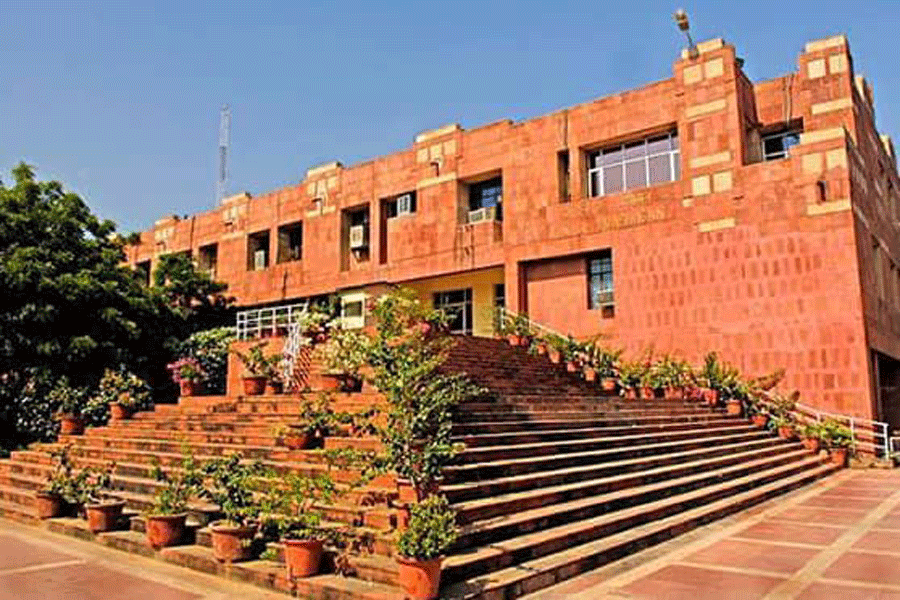
Students of Jadavpur University were treated to a presentation on graphic novels and Will Eisner on Thursday. Eisner, as described by ‘comicist’ Sarnath Banerjee who made the presentation, may be called the “uncle of the graphic novel”.

At the event, held in the department of English, Banerjee talked about and showed slides from the works of Eisner, including A Contract With God — his most well-known work — and Jacques Tardi, a French comics creator.

Will Eisner was born in Brooklyn, New York, in 1917 to Jewish immigrants and spent most of his life in the Bronx. He made his debut in comics in 1936, when WOW What a Magazine! published his first works, Karry and The Flame. The magazine folded, but Eisner teamed up with friend Jerry Iger to found the Eisner-Iger Studio. Together, they put out comics in all genres and styles.

Through the 50s, Eisner produced remarkable comics, including the very popular The Spirit, an innovative strip about a masked detective.

But it is on A Contract with God that his fame chiefly rests. As the first true modern graphic novel, it revolutionised the comics medium with its publication in 1978.

This semi-autobiographical work captures in pen and ink the drama of the city and its all-too-human inhabitants. Set in the same Bronx neighbourhood as his later works Dropsie Avenue and A Life Force, the stories in Contract examine the world of immigrant life in New York City in the 1930s with a peek into the emotions and character of its denizens.

At the presentation, Banerjee also showed a claymation film of his own, based on a chapter of his recently published graphic novel Corridor. The 50-odd students and a clutch of faculty seemed to have enjoyed both. The department teaches a core course on comics at the undergraduate level.


Of books and music

Living Other Lives, a collection of poems by Sharmila Ray, was released by author Sunil Gangopadhyay at Landmark on Wednesday. The cover of the book has been designed by M.F. Husain.

The store will host Neeraj Sridhar of Bombay Vikings, the band topping the indipop charts with its Chhod Do Anchal number. On Saturday, Sridhar will belt out tracks from the album from 3 pm.

• A variety programme will be organised by The Indian Association of Retired Persons on its premises on Saturday evening. The function, celebrating Baisakhi, will feature recitals by Srabani Sen and Debmalya Chatterjee.

Top
Email This Page