|
|
| Danger behind every
bush |
It is not often that policemen
publicly seek the support of the media. The recent plea
of Ranchi’s police superintendent was, thus, unusual. Stung
by media criticism that his men were picking up innocent
tribals and accusing them of sheltering extremists, the
SP pleaded for better understanding. Four of his men had
been killed in an ambush, barely 25 kilometres from the
state capital, but even after a week-and-a-half of relentless
combing, he could only lay his hands on some emaciated,
unarmed and innocent-looking villagers. The armed squad
of militants, that had sprayed the jeep his men were travelling
in with bullets from machine guns, had melted away in the
surrounding forests. And the police clearly had no clue
about their whereabouts or movement.
The mainstream media in “shining”
India have chosen to ignore the crisis brewing in Jharkhand.
In Hazaribagh, Palamau, Lohardaga, Chatra, Bokaro, Giridih,
Singbhum and now Ranchi, land-mines have been blowing up
at regular intervals; policemen are being ambushed, police
stations attacked and their firearms snatched. While the
Jharkhand police have tried their best to gloss over the
incidents, Central agencies have more accurately assessed
the scale of the threat and the number of strikes on the
ground. Their reports are perhaps more alarmist as a result,
but also far closer to the reality on the ground.
The police too have claimed several
successes, in terms of the number of “commanders” killed,
the recovery of a huge amount of cash hidden in the forest,
the rescue of some of those abducted and inroads made into
some extremist strongholds. But on balance, it has been
an unequal battle, with the militants’ hit-and-run strategy
catching the police by surprise more often than not. Anti-social
elements have predictably taken advantage of the prevailing
anarchy, often invoking the name of extremist groups to
strike terror or gain respectability.
What’s new, one might ask. For
the past 20 years, the police in several states have struggled
to put down the idealist and the downtrodden’s romance with
revolution. With increasing dollops of CHARM (communication,
hospitality, arms, roads and money), the police have sought
to eliminate the rebels and neutralize the converts. But
it has not had much effect. The radical or the idealist
left have increased their spheres of influence and intelligence
agencies have begun speaking of a “red corridor” extending
from Nepal in the north to Kerala, down south. Security
agencies have so far waged a losing battle, and there is,
of late, a grudging admission that an unfair, partisan and
ruthless administration can never hope to fight dreams successfully.
The failure of Jharkhand to ensure a fair administration
had to culminate in a resistance that is now bleeding both
sides.
The Ranchi SP pointed out that
Naxalite groups were not just using children to carry messages
and report on the movement of policemen, but they were also
recruiting the services of retired defence and police personnel.
In several districts, the extremists had issued a fiat that
one able-bodied youth from each family should join their
squads. Sandwiched thus between the young and old, one can
sympathize with the policemen who are never sure from where
the bullets will come next. The inevitable has happened
— the police have begun to give vent to their frustration
by detaining villagers on suspicion, interrogating them
or subjecting them to a worse treatment, and accusing them
of providing logistical support to the extremists.
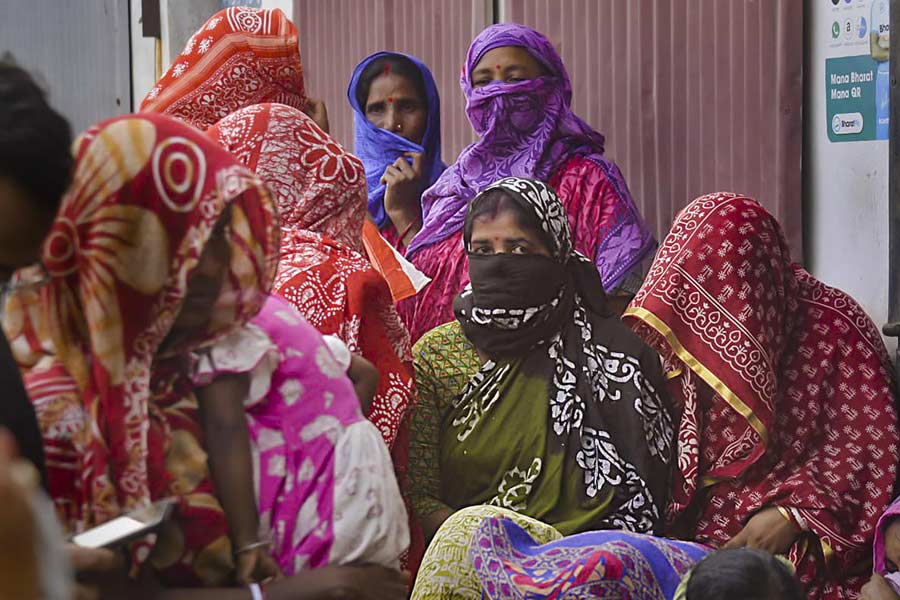
Like the policemen, the villagers
too , appear sandwiched between the extremists and men in
khaki. The extremists, possibly, are the more frequent visitors,
and the villagers can hardly afford to refuse them food
or shelter. Infrequent visits by the police, one suspects,
is one of many reasons why villagers deny even information
to the men in khaki. There is little love lost between the
villagers and police, even at the best of times. In times
of crises, mutual suspicion cripples any working relationship
and trust between the two. The result is invariably tragic.
The arrests are generally indiscriminate and the poor villagers,
mostly tribals, are left to fend for themselves with little
or no legal assistance. Many families are ruined and the
social fabric damaged beyond repair.
Policemen obviously do not have
the patience to appreciate the process of alienation and
change in society. As the SP would point out, their job
involves apprehending people who are waging a war on the
state, and people who support or sustain the guerillas are
equally guilty and cannot escape retribution. But just as
Naxalite violence is counter-productive and invites even
more ruthless retaliation, police repression too leads to
tragic consequences.
The police recently arrested a
man who, they alleged, had presided over two people’s courts
which had sentenced two villagers. The poor tribal did not
deny the fact but pleaded that he had been asked by the
extremists to preside over the session and could scarcely
refuse. But now that he has been arrested and charged with
being a collaborator, he may well have to close down his
little tea shop and face a long bout of litigation that
will reduce him to a pauper and send him to jail for a long
time, if not the rest of his life. His family members then
would have little option but to fall back on the extremist
groups for sustenance.
While the rulers are known to
follow the practice of “divide and rule”, in Jharkhand one
can see the extremists also doing the same. Playing one
group against another or some mainstream politicians and
parties against their rivals, and drafting some of the lumpen
elements to counter others, they have succeeded in confusing
the rulers. In the process, they have also gained valuable
breathing time and a support base for themselves. The administration
keeps repeating the mistake of treating extremists as a
rag-tag group of misguided men. It certainly required far
greater organizational skills, motivation, money and mobilization,
than the government is prepared to accept, to hold the administration
to ransom in 16 or more districts of the state.
A section of the police have put
up street plays to highlight the futility of extremism;
they have tried to educate the villagers about the law,
and to reach out to them with medicine, toys, food and textbooks.
They have sought to reply to the ultras’ propaganda war
by telling their own version of the truth. They have also
tried the somewhat dangerous strategy of arming villagers
to take on the extremists. Communication equipment and firearms
have been given to villagers to report on the movement and
eliminate, if possible, the banned armed squads. A couple
of “lynchings” of Naxalites in east and west Singbhum, however,
has failed to stop or stem the increasing number of Naxalite
strikes. On the other hand, several vigilante groups set
up by the police have spun out of control and found robbery
to be a relatively easier means of earning more money.
The unholy mess in Jharkhand shows
no sign of being resolved soon, at least not until the government
realizes that it cannot fight a “just war” against its own
people. The devolution of power through panchayats
could have been one way out. But with the clock ticking
for the general elections, the state is once again likely
to get away by putting off the panchayat polls which have
not been held in the last two decades.
|