TT Epaper LHS
The Telegraph
TT Mobile
 
 
IN TODAY'S PAPER
CITY NEWSLINES
 
 
ARCHIVES
Since 1st March, 1999
 
THE TELEGRAPH
 
CIMA Gallary
 
Email This Page
END OF IDEOLOGY

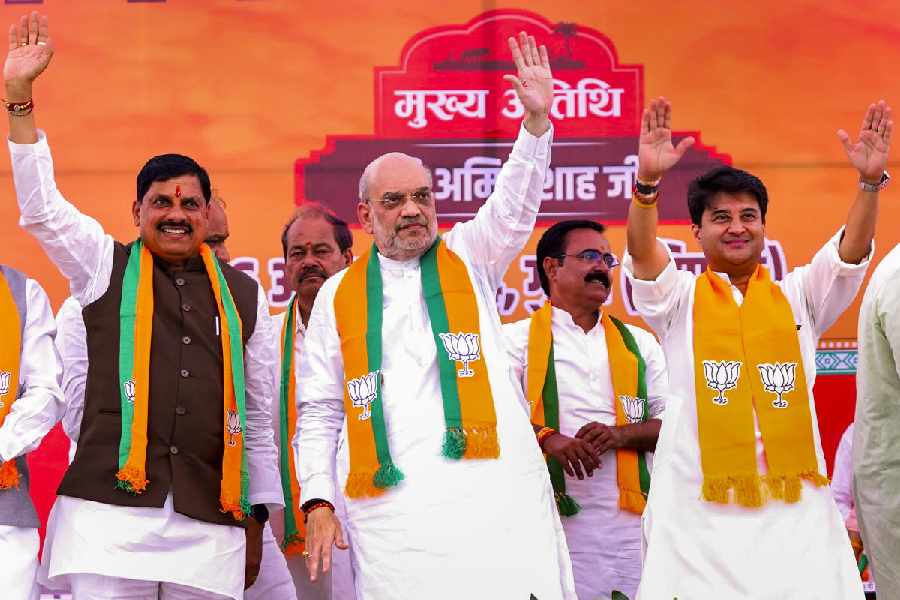
Words change their meanings as contexts alter. Sometimes users endow words with different meanings to suit their convenience. The word Hindutva, since it was first invoked in a particular way by V.D. Savarkar, has come to signify a militant form of Hindu fundamentalism, at the core of which lies a hatred of religious minorities in India, especially Muslims. Hindutva has been the official slogan of the Bharatiya Janata Party but under Mr Atal Bihari Vajpayee, the word has been endowed with a completely different emphasis. Mr Vajpayee, against some opposition from the sangh parivar, has removed from Hindutva its hard outer shell of militancy and hatred. The word Hindutva has not been dropped but it has been vacated of its ideological and programmatic content. Under Mr Vajpayee, in the national executive of the BJP in Hyderabad, Hindutva has received a new content. The bottle is an old one but the wine is new. Hindutva, in the new BJP lexicon, is meant to connote “all round progress of India”. The stress on the majoritarian community has been elided. This change has been long in the making and the determining influence has been the compulsion of coalition politics. The coalition partners in the National Democratic Alliance made it clear that they had no time for Hindutva and the Ram mandir. The net impact of this was a shift in the attention of the BJP to issues of governance and development. It is this focus that has defined Mr Vajpayee’s leadership of the government and the party.

The resolutions of the national executive show that the BJP, in its own self-image, has now established itself as the party of governance and of the middle ground. The point is important for a number of reasons. This change, even though it has profound implications for Indian politics, is not being recognized by the critics and the supporters of the BJP. In its new avatar, the BJP has appropriated what was traditionally the Congress’s turf. Without its fundamentalist identity-kit, the BJP’s differences with the Congress have become more and more blurred. The party of saffron now appears as the legitimate bearer of the tricolour. The transformation of the BJP is also a demonstration of another unacknowledged phenomenon of Indian politics: the holding of office invariably blunts the extreme edges of a political party. Witness, the BJP and the Communist Party of India (Marxist) in West Bengal.

It can be argued that the system has tamed the tiger in the BJP. Such a view, not totally invalid, ignores the efforts and achievements of Mr Vajpayee. The latter has consistently tried to project himself as the prime minister of India and to rise above sectarian considerations. Here his main battle has been against sections of the sangh parivar who remained shackled to Savarkar’s original meaning of Hindutva. Mr Vajpayee has rewritten the gospel to meet the demands of power and governance. It is obvious that these are now the BJP’s principal priorities.

Top
Email This Page