|
|
| Value addition |
Following the recent leak of the
CAT question paper, a number of questions are being asked
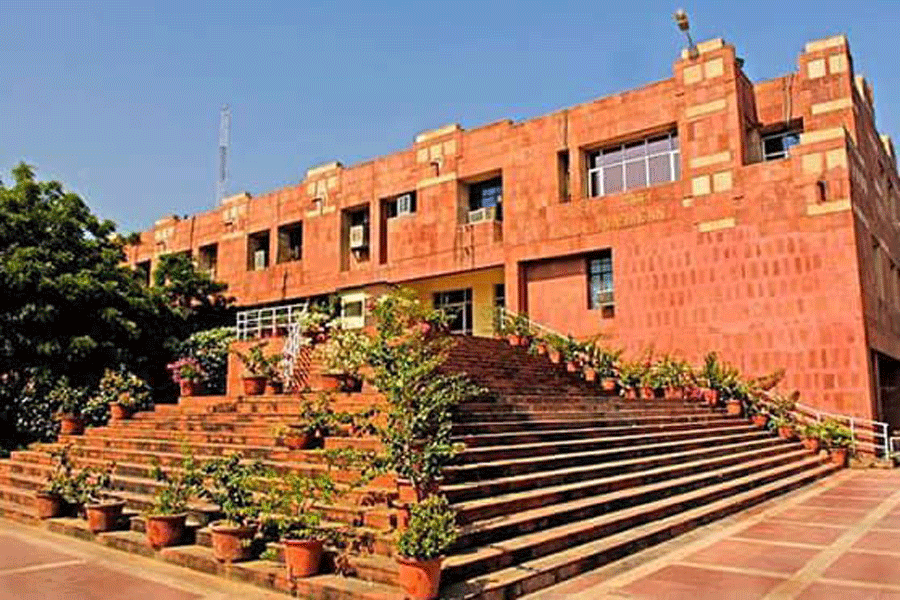
in the media regarding the role of the Indian Institutes
of Management and CAT in today’s India. These deserve discussion
and debate.
The first question: what roles
are the IIMs supposed to perform in a country like India?
The IIMs were established in the early Sixties. Even “socialist”
leaders like Jawaharlal Nehru found an urgent need for institutes
that would produce and train managers for the public and
the private sectors. The shortage of professional managers,
like shortage of capital, was regarded a crucial constraint
on India’s industrialization drive. Today, the two Indian
brands that are globally accepted as world class are the
IITs and IIMs. Graduates from these institutes are welcomed
on the payrolls of employers all over the world .
Of course, there are the doubting
Thomases. Some think that managers cannot be produced in
business schools. Many great businessmen are self-taught.
True. But they miss a few points. First, what can be learned
through years of experience and “doing” can often be mastered
in a much shorter time though systematic education. Some
of the top “unschooled” managers have openly recognized
this.
Second, today’s business world
is much more complex and competitive than it was earlier.
All scope for cost cutting, productivity improvement and
other ways of enhancing bottom lines by the use of sophisticated
state-of-the-art techniques must be exhausted for survival.
It was not so in older days of “protectionism” and licence-permit
raj.
Third, businessmen are not fools.
They would not have paid such high salaries to IIM graduates
over such a long period if they had not got their money’s
worth. One may still argue that it is not for their training
at the IIMs but the fact that they have been screened several
times by such demanding tests as the IIT joint entrance
examination and then again the IIM-CAT which gives them
their astronomical market value.
That is partly true but certainly
not the full explanation. Ask any IIM graduate and he would
vouch for the value added though quality education at the
IIMs. In any case, that brings us to the question of the
value of CAT. This year nearly 1.3 lakh students are competing
for the 1,200-odd seats at the six IIMs. The CAT is a written
test which evaluates a student’s quantitative, analytical
and verbal skills. Those who score very high are then called
for a group discussion and personal interviews. The CAT
scores, the scores at the GD and the interviews, past academic
achievements are all taken into consideration, with pre-determined
weights, to prepare a composite score and the final selection
is made strictly according to this list.
There is not a single known case
where a student has entered IIMs through the back door,
by violating the merit list, despite intense pressures from
different quarters. One circumstantial evidence would be
to verify how few (almost non-existent) among the successful
entrants to IIMs are the sons and daughters of IIM faculty
or board members. This shows how scrupulously the sanctity
of CAT and the admission procedure has been maintained over
the years. This year’s leakage, which most probably happened
at the press, is an aberration. Nonetheless, it is a matter
of deep regret and concern, specially as the IIT-JEE question
paper also got leaked a few years ago. This shows how vigilant
the test administrators need to be against unscrupulous
people who can do anything to enter the bastions of merit.
How about the suggestion that
CAT be replaced by a single uniform national test for all
management schools and that personal interviews be done
away with? Apparently, this would reduce the hassles of
students. But imagine that a few undeserving students, who
paid a few lakhs to buy the question paper and answers,
manage to get through the CAT. At least, under the present
system, there is a fair chance that they would be screened
out at the interview stage. Moreover, the GDs and interviews
are meant to check the communication skills and leadership
qualities of the student which are so essential for managers.
The problem with a single admission
test for all management institutes is that the difference
in the quality of applicants and management schools is so
great in India that it is nearly impossible to devise a
single test which will be able to differentiate students
properly. The CAT is meant to screen out the really bright
from the rest. If all students are made to go through a
CAT-like super-difficult test, many of them would score
very poorly and there would be so much bunching at the lower
levels that it would not be possible to differentiate between
them. So, there will have to be a different test for such
students. For similar reasons, the Indian administrative
services examination has been kept different from the state-level
administrative service exams.
The counter-argument is that all
management students in the United States of America go through
a single test called the GMAT. Why not in India? A few points
need to be noted here. The difference in quality between
the top business schools and the bottom schools in the US
would be much less than the corresponding difference in
India. Unfortunately in India, the All India Council of
Technical Education and various universities have given
approval to hundreds of management institutes which have
mushroomed without the required infrastructure and good
quality faculty. The standards of students going into such
institutes would also be correspondingly low.
Second, the GMAT has been a world-wide
test backed by enormous resources. A great deal of research
has been done over many years to make it scientifically
valid for a wide cross-section of students. The current
paper-setters of CAT or any other body in India are simply
not equipped to design such a test at this point of time.
Third, the GMAT is not a pencil
and paper test. For several years now, the GMAT (and GRE)
has been made an online test taken by students sitting at
a computer terminal at the testing centre. One can sit for
the test any day throughout the year. This is a big advantage
over the CAT which has to be taken on a fixed day throughout
India, irrespective of the student’s convenience. “Why can’t
applicants to the IIMs take the GMAT (instead of the CAT),
which is conducted throughout the year by the Educational
Testing Service of the US?” ask some students.
There are several problems. One,
the GMAT is more than ten times expensive (costing around
$ 225 or more than Rs 10,000) than the CAT (which costs
around Rs 1,000). Two, logistically it is nearly impossible
for 1.3 lakh students to take online computer tests at ETS
test centres even if the examination is spread over several
months. For example, in Calcutta there is only one ETS test
centre for GMAT. Further, each test centre has a small number
of properly equipped computer terminals. Third, applicants
from remote areas or from poor families may not have adequate
familiarity with computers and computer-based tests. They
will be at a distinct disadvantage, relative to others.
For all these reasons it is not practicable to substitute
the CAT with the GMAT, at this point of time.
Finally, there is a feeling that
the fees charged by the IIMs — around Rs 3 lakh over a two
year period — are exorbitant for a poor country like India.
Here, remember that the average starting salary of an IIM
graduate is around Rs 6 lakh per annum. So, the two year
fees amount to only six months of their first year’s salary.
Why should they not pay for the cost of the high-class facilities
they enjoy when they can afford to pay?
For poor students, the IIMs provide
many scholarships. These can be further increased. Banks
are also eager to give loans to IIM students because repayment
is no problem. The government, since the early Nineties,
has been insisting that higher education — especially institutions
of engineering and management — should be self-financing
as far as possible. The IIMs are the one place where this
policy can be implemented, without compromising the equity
principle.
|