|
|
Far ahead
|
It is hard for an Indian of my
generation to call Calcutta Kolkata, and harder still for
him to refer to Trivandrum as Thiruvananthapuram. Bengal’s
capital I know well, having spent five years there as a
young man. But I recently made my first trip to Kerala’s
capital. This is a charming town of old tiled houses and
curving roads, situated at the southern edge of the state.
Trivandrum was once the capital of the princely state of
Travancore-Cochin, whose ruling dynasty, the Varmas, had
a marked talent for the arts. (Raja Ravi Varma belonged
to the family, while their wooden palace in Padmanabhapura
is one of the wonders of late medieval architecture.)
My first visit to Kerala, to the
industrial centre of Cochin, was at the invitation of that
remarkable peoples’ science group, the Kerala Sastra Sahitya
Parishad. KSSP is a non-profit organization that runs itself
through the proceeds of the books and pamphlets it publishes.
My second visit, to the village of Thiruvala, was to attend
a meeting convened by the followers of the liberation theologian,
M.M. Thomas. The present visit to Trivandrum was at the
invitation of DC Books, who are the state’s largest commercial
publishing house, and also own a chain of bookshops. Thus
on each of the three occasions I have been in Kerala I was
placed in the midst of writers and intellectuals, arguing,
arguing, arguing. It is hardly surprising that I was reminded
of my days as a doctoral student in Calcutta.
As in Bengal, in Kerala too books
and ideas are taken very seriously indeed. These are probably
the only two bilingual intellectual cultures in India. In
Trivandrum I met Paul Zachariah, a masterful short story
writer in Malayalam who also writes well crafted essays
in English. I also met the veteran historian M.G.S. Narayanan,
who publishes his research papers in English but is also
a prolific contributor to the Malayalam press. Like his
Calcutta counterpart, the Trivandrum writer and scholar
lives simultaneously in his locality and in the world. He
knows his Vallathol and his Basheer, but also his Foucault
and his Sartre. (As in Bengal, there is here a noticeable
enthusiasm for French thinkers as opposed to Anglo-Saxon
ones.)
Both states also have an enduring
tradition of art cinema. The cinema opposite my hotel was
showing the latest film of Adoor Gopalakrishnan, an exploration
of late colonial India through the eyes of a hangman. In
the Hindi cinema, the days of Shyam Benegal and company
are a fading memory. In Tamil and Telugu films the bottom
line has always ruled. But in Kerala, like in Bengal, there
is still space for the innovative director who makes films
which provoke but do not necessarily sell.
In both states, thinkers and creative
artists divide themselves into rival camps. Thus Paul Zachariah
describes himself as a “man of the left”. The historian
M.G.S. Narayanan, on the other hand, is best described as
a man of the “anti-left”. Of course, there are various shades
of opinion within each camp, but the fundamental axis of
division remains the relation to Marxism. For one set of
intellectuals, this philosophy is both enlightening and
emancipatory; for the other, it is constraining and dogmatic.
This polarization is a consequence
of the hegemonic role in both states of the Communist Party.
The undivided Communist Party of India came to office in
Kerala in 1957; over the next forty-five years it has been
in and out of office. The state has a stable two-front system,
one alliance led by the Communist Party of India (Marxists),
the other by the Congress. In West Bengal, the communists
first tasted power only in the late Sixties. But from 1977
they have never been in opposition.
In both Kerala and West Bengal
the communists have tried not merely to define the terms
of cultural debate, but also to control it. It is now widely
recognized that senior appointments in West Bengal’s universities
are decided upon by Alimuddin Street. In Kerala the party
headquarters, the A.K.G. Centre in Trivandrum, plays a very
similar role. However, its influence is limited in comparison,
if only because in every alternate election the communists
are thrown out of office.
The vigour and vitality of intellectual
life, its effortless bilingualism, the salience of the left
— all these make Kerala akin to Bengal. One could add other
similarities, such as the absence of communal strife, or,
on the negative side, the power of the trade unions which
has led in both states to a flight of capital. But there
are also some fundamental areas of divergence. One is social
composition. While both states have a large Muslim population,
Kerala also has a wealthy and influential Christian minority.
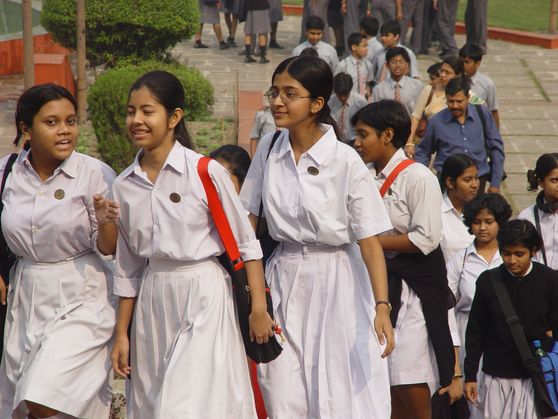
The other is social development — while Kerala has an outstanding
record in education and health, Bengal has fared rather
poorly in this regard.
“Success has many fathers,” said
John F. Kennedy. Thus angels of all kinds have rushed in
to claim credit for the “Kerala miracle”: for the fact that
the state has almost 100 per cent of its female population
literate, the fact that its population growth rate is the
lowest in India, the fact that its health facilities are
better than in the United States of America. The Travancore
ruling family liked to say that it devoted more energies
to education than other Indian princes, by, for instance,
sending women doctors and nurses abroad for training. The
dominant caste of the Nairs is not shy of staking its claim
either. The Nairs are matrilineal, with women inheriting
and running family properties; this is said to have made
it easier to send little girls to schools. Then there are
the Christian missionaries, who believe that they brought
an enlightened modern perspective through the colleges and
hospitals they run in Kerala. The previously oppressed caste
of Ezhavas point to the movement of social reform led by
their great leader Sree Narayana Guru, which first generated
the atmosphere of equality that now pervades the state.
Finally, there are the communists, who argue that it was
they who created true equality of opportunity, through thoroughgoing
land reforms which removed the power of the old landed elite.
The best discussion of the Kerala
miracle is to be found in Robin Jeffrey’s book, Politics,
Women and Wellbeing. There, the contributions of these
varied streams — feudal progressiveness, Nair matriliny,
Christian charity, Ezhava assertion, and communist redistribution
— are carefully weighed and assessed. A rather different
“take” on the subject was offered by that brilliant, maverick
environmentalist, the late Anil Agarwal. The reason why
girls go to school in Kerala, said Agarwal, was because
of the super-abundance of wood and water. For in other parts
of India the girl-child is expected to help her mother gather
fuel for the stove and water for the household. In arid
or hilly regions these tasks can take up to four hours:
that is, the entire morning, which the boys spend in school.
But in Kerala there is green cover all around, and plenty
of water too. It is Mother Nature, not Political Culture,
that frees the women from these tasks, allowing them to
be educated and to work, to choose when to get married and
how many children to have.
Now the interesting thing, pace
Anil Agarwal, is that West Bengal is as richly endowed by
nature as Kerala. There is water everywhere, and wood almost
everywhere. Why then does it have an altogether modest record
in education, health and women’s rights? The Congress, whether
Trinamool or orthodox, claim that the problem lies in the
“tyranny of left rule”. And the communists shift the blame
to the government of India — Centre kom diyechhe,
they say. Such, for the past two decades and more, has been
the blame-game of Bengali politics. The rhetoric brings
to mind the second part of John F. Kennedy’s famous statement.
Remember that while success has many fathers, failure is
an orphan.
|