|
|
| Low priority |
All its sycophants, ones that
wait with bated breath and whispering humbleness for the
hyenas’ shares of the leftovers, must pursue with diligence
whatever edicts emerge from the superpower. The society
we live in is no exception to this. As soon as the United
States of America declared the need for higher education
to be self-financing, we decided to join the bandwagon without
a slightest thought about the attributes that distinguish
the two societies. And one of the most important differences
between them lies in the quality of education that an average
individual has received. One does not need to quote statistics
to prove that the US or other similarly placed countries
have a population that is incomparably superior in terms
of its educational characteristics.
Thus, recession induced cuts in
the state university budgets cause little harm in the US
compared to the devastation it leads to in poorer countries.
There are at least two reasons why a deceleration in the
growth of institutions of higher education in India will
precipitate long-term damages in this country. The first
of these will harm its social fabric irreparably, while
the second will precipitate an economic ruin of absurd proportions.
To start with the social phenomenon,
one feels tempted to quote from the celebrated court scene
in The Merchant of Venice: “As there is no firm reason
to be render’d,/...So can I give no reason, nor I will not...”
Shylock said this in rage when called upon to justify his
maniacal preference for a pound of Antonio’s flesh over
the three thousand ducats that the latter owed him, merely
because the payment had not been made on time. However abused
by the Christian community, a part of Shylock’s ultimate
tragedy lay surely in his refusal to listen to the voice
of reason. But passion, engendered by a lack of education,
is a force that finds expression in the destruction of all
and sundry and, unlike the finale in Shylock’s story, can
smother to extinction centuries of creativity that reason
alone can foster.
Passion leads to mindless destruction.
Or else, why should the magnificent library and museum at
Alexandria have perished in a civil war? The Greeks lost
their geometry to the Barbarians, to be retrieved by the
Arabs, but only fortuitously. And closer to home, both in
space and time, could primary education alone, which in
this society may not amount to much more than a vague knowledge
of the alphabet, prevent the Gujarat outrage? Right now,
lunacy reigns supreme in Ayodhya. The Archeological Survey
of India is engaged in a journey to the centre of the earth
to substantiate mortal claims about godly hierarchies.
The coffers are declared, however,
to be empty when it comes to educating people, though the
most important product of education is reason. Imparting
higher education is an activity that is rapidly acquiring
the complexion of sinful luxury. The logic indeed is imported
from the Yankee world. A beauty parlour gives a haircut
to improve your appearance, an extravagance only the rich
can afford. An orthodontist gives your teeth a texture as
smooth as alabaster, a need that may be felt by the likes
of Karisma Kapoor. All such services lead to observable
and verifiable personal gains and must be paid for.
Unfortunately though, the personal
gains are less palpable for the services rendered by a college
or a university teacher. A professor of history analyses
for you events that occurred in the distant past. A mathematician
expounds on the wonders of logical paradoxes. Like the barber
and the dentist, the professor is also supplying a service,
which amounts to selling to the customer a right to a claim
on his expertise. The benefit, however, that it imparts
to society at large is not readily measurable by means of
a pair of scales. Yet, it is only a well-educated society
that can appreciate the worth of human learning.
An interesting anecdote concerning
Euclid illustrates the point. To quote from Russell’s History
of Western Philosophy, “It is said that a pupil, after
listening to a demonstration, asked what he would gain by
learning geometry, whereupon Euclid called a slave and said
‘Give the young man three-pence, since he must needs make
a gain out of what he learns.’ ... No one in Greek times,
supposed that conic sections had any utility; at last, in
the seventeenth century, Galileo discovered that projectiles
move in parabolas, and Kepler discovered that planets moved
in ellipses.”
The Euclid story demonstrates
that the love for pure knowledge is not as sinful as it
is currently being made out to be. Indeed, there is a curious
similarity between business investments and academic research.
In both cases the result is uncertain. Only, in the first
case, the gains and the losses show up within a reasonably
short duration of time. In the latter case, it could take
years. The trouble of course is that politicians, like business
houses, are concerned with the short run. No one understands
better than a politician the meaning of Keynes’ dictum,
“In the long run we are all dead”.
Coming over to the economic gains
of higher education, ministers cry themselves hoarse over
the growth rate of economies. Recent research in economic
theory has demonstrated beyond doubt that the growth rate
of an economy depends as much on investment in physical
capital accumulation as on the development of an educated
labour force. The same physical capital equipment is more
productive in the hands of a highly skilled individual than
it is in the hands of an unskilled worker.
Societies progress economically
not merely through the accumulation of physical capital,
but also through what has now been widely recognized as
human capital. As the Nobel Laureate Robert Lucas pointed
out, productivity of capital is low in societies where the
quality of the labour force is poor. If this were not the
case, then capital deficient economies could gain significantly
from the flow of capital from richer societies. The fact,
however, is that poorer societies do not attract capital
on account of the low performance of their labour force.
However indirect and delayed may
be the intended effects of higher education, a government
fails in its duty if it accords to it a priority that is
less than what it deserves. On the other hand, it is also
a fact that government finances are in the doldrums all
over the world. The announced policies requiring institutions
of higher education to collaborate with the private sector
by inviting income-generating projects for the institutions
seem to be of dubious value.
First of all, do college or university
teachers have the time available to work on income-earning
projects after performing their teaching responsibilities?
Particularly so for undergraduate colleges, where the norm
during peak seasons is that a teacher deliver twenty-four
lectures a week?
Secondly, academic research is
more often than not as far removed from projects offered
by business houses to calculate the expected profitability
of their contemplated ventures. Indeed, a college teacher
or a university professor may turn out to be highly successful
in generating funds through business projects, without adding
an iota to the creation of knowledge for the youngsters
who attend the classes.
Can capital markets help? Unlikely,
for banks stand ready to lend to would-be MBAs, but not
to others. For them, higher education is too risky an investment.
For the government, on the other hand, it is a vice that
a developing economy can ill afford. Universities had therefore
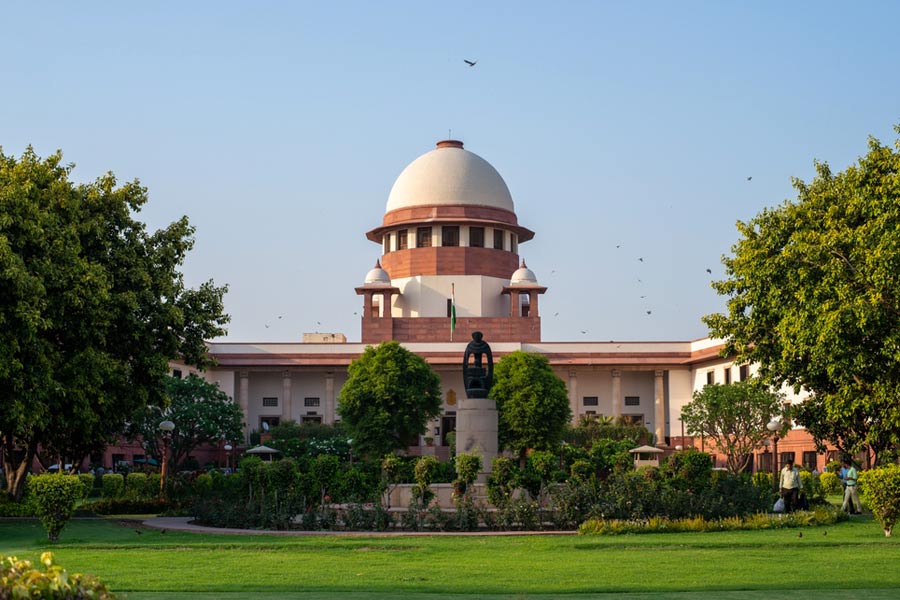
started to charge capitation fees, which the Supreme Court
has now banned. Can institutions of higher education survive
in this scenario?
Perhaps the rich will find a solution
for their children. Send them abroad. In the meantime what
sort of a society shall we be heading towards? For whom
indeed are the bells tolling?
|