| |
Tiger Thackeray at a party meeting | Mumbai,
June 26: For the first time in his life, Balasaheb Thackeray has competition.
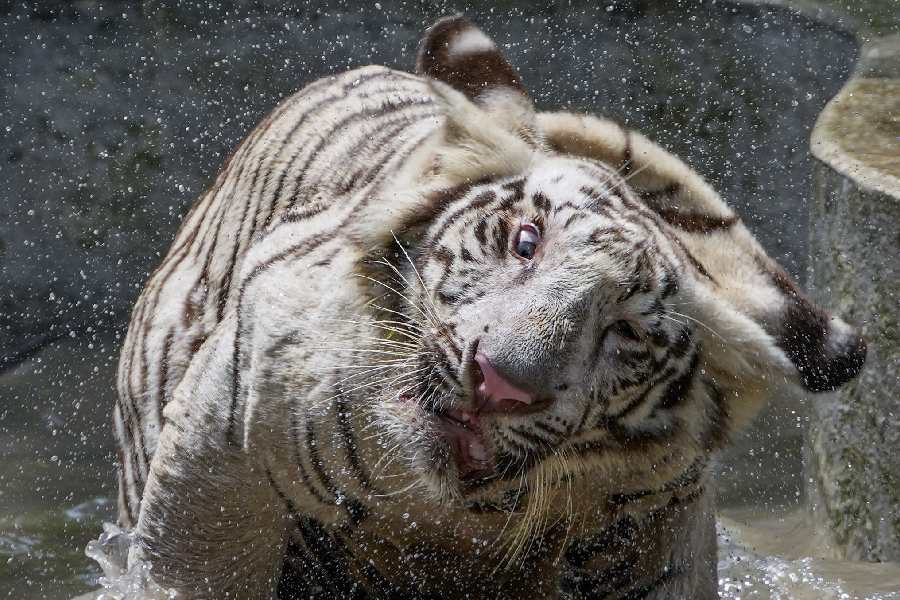
A tiger has been sighted in the vicinity of Mumbai that has been Thackeray’s unchallenged
territory for as long as anyone can remember. The
animal, spotted and filmed in the Sanjay Gandhi National Park, a forest that stretches
from the northern suburbs of Mumbai, could be a female, said S. Bharati, deputy
conservator of forest. But environmentalists following
the big cat’s pug marks say they are not sure of its gender. The
forest official also said the tiger probably had a companion nearby, though the
environmentalists were not sure of that either. But everyone agrees that this
means the re-entry of the species into the forest after a long hiatus. Shiv
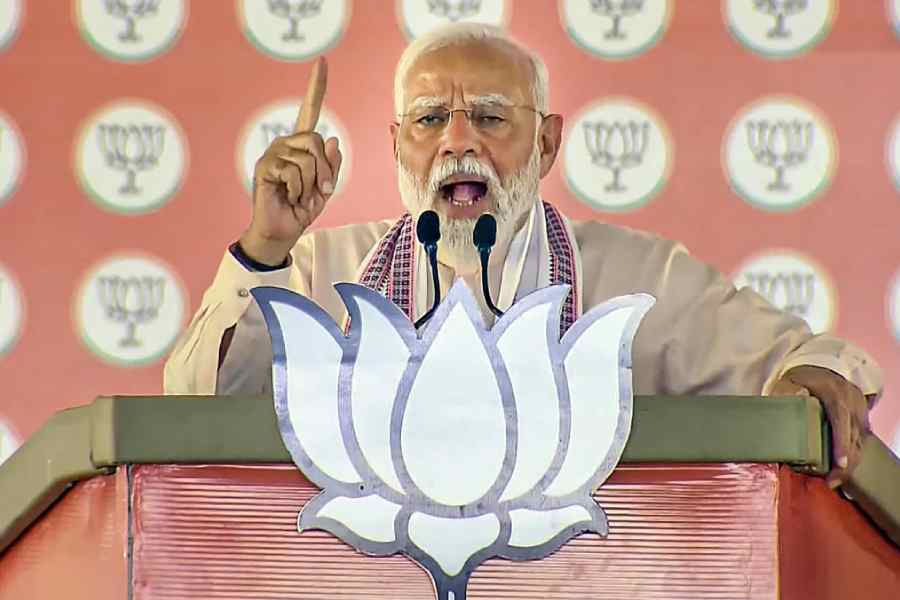
Sena leader Thackeray, 77, is often referred to as the tiger, which is also the
emblem of his party. Subhash Desai, a senior Sena leader, said the party had adopted
this symbol because of the tiger’s aggressive nature and its stripes — a tiger
doesn’t change its stripes, the saying goes. Nor does Thackeray. The
tiger is also the vehicle of Goddess Amba Mata, worshipped in Maharashtra. “The
last time a tiger was seen in these parts was in 1927,” said environmentalist
Devi Goenka, who has been running a campaign against encroachers in the national
park. But that animal was shot. If what Goenka
said is correct, this tiger has travelled a long way — possibly from the Dangs
forests in Bhuj, Gujarat, through Nashik, Thane and the Tungareshwar forest in
Maharashtra. Goenka said four or five tigers have
been reported in the Dangs area, which earned notoriety some years ago because
missionaries had come under attack over allegations of forced conversions. “There
were reports of a tiger sighting for the last few months. First we saw pug marks,
then we saw some hair,” Goenka said. Casts were made of the pug marks and tested. Some
tiger excreta was also spotted and the samples were sent to the Wildlife Institute
of India at Dehra Dun. But it was only two weeks
ago that the animal was seen. Ulhas Karanth, a wildlife expert from Bangalore,
had put up three cameras to photograph the animal. But Karanth could not photograph
the animal when it appeared. An NGO worker, Mayur Kamat, filmed it with his video
camera at a spot that is about 15 km from Borivli, the bustling suburb that marks
the end of Mumbai district. Ashish Fernandes of
Sanctuary Features said the animal could have strayed into the area looking for
a new hunting ground. It could be an older tiger unable to cope with competition
from its progeny, or a male sub-adult looking for new territory. The
tiger’s appearance has rekindled the debate on encroachment in the area. Some
activists argue that predatory animal presence in the park is a threat to human
habitation, which includes slums and tribal settlements. Fernandes,
representing the other side and concerned about the well-being of wildlife, said
the tiger would find it easier to survive if there was a companion in the neighbouring
Tungareshwar forest, which was likely. Farther
from the city, Tungareshwar may in any case be a safer place. There may not be
enough space in and around Mumbai for two tigers. |