|
|
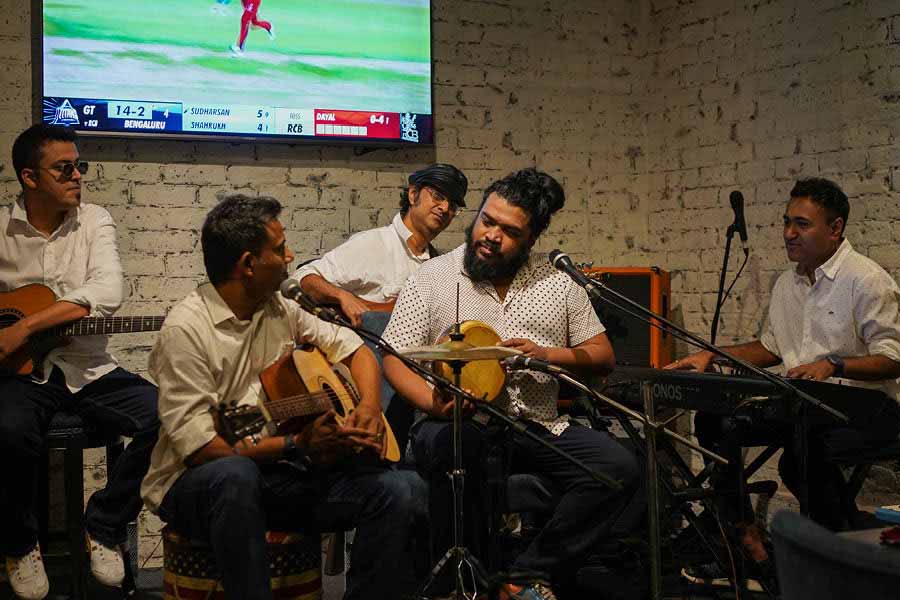
The author on song with husband George Sibley by her
side |
6.50 am. The doorbell downstairs
rings and I wake up suddenly. It must be Paul, one of our
two junior officers at the consulate, coming to meet my
husband, George Sibley, the US consul general in Calcutta,
to go play squash at the Calcutta Racquet Club.
George leaves and I decide to
go to my desk on our verandah to check e-mails on my computer.
This will take all the time George is out playing as I receive
an average of 15 e-mails a day and try to answer them all
so I don’t fall behind in my correspondence. Some news from
my Calcutta Hash Group. I’m the Hash Mistress, in charge
of sending out weekly information on our Sunday runs, keeping
track of the bank account, disbursing funds, handling Hash
correspondence, and barking out instructions each week before
the 40-member group sets out on its course. More news from
my friends in Jordan and their thoughts on the war in Iraq,
and some messages from the Internet forwarded by family
in the US. By the time I finish, George is back.
8 am. We have breakfast.
Our head bearer, Lal, serves it to us on a silver tray upstairs
on the verandah. As I’m enjoying the fruit and yoghurt,
fresh coffee and bread, I keep the tape running in my head
–“enjoy it, but don’t get used to it” – George’s words of
wisdom. After breakfast, we move to the sofa for a bit of
CNN and to read five English daily newspapers.
10 am. Before I leave for
my first appointment, I go over the plans for the evening
and for the coming weekend with George’s assistant, Amada.
I say a quick “goodbye” to my mom and go downstairs to check
in with the house staff about today’s meals and telephone
messages. Outside, I greet my driver, Abdul, and my personal
security officer on assignment from the police department.
Each day, since the war in Iraq began, a different policeman
has accompanied me whenever I leave the house. There have
been daily marches protesting the war, with as many as 150,000
people walking and holding up anti-US placards. Windows
were broken at the American Center, a few blocks from the
US Consulate, and rotten eggs were thrown as well. The windows
of the Nike shop around the corner from us were vandalised
by a group of young men because it was a so-called “American
business”. Forget that the employees and the owner of the
shop are Indian, that the shoes are manufactured in Asia.
Who will give them jobs if their business has to shut down?
The protesters? Because of recent events, and the fact that
my first appointment is fairly far away in Barisha, there
is a police escort jeep waiting for me and we will follow
it to the Rehabilitation Centres for Children. I ask Abdul
to tell the police vehicle not to go too fast — Calcutta
traffic is frightening enough without trying to keep up
with a car whose siren is blasting as it speeds past buses,
bicycles, taxis, rickshaws and pedestrians …. and cows!
As we ride through the city, I
am filled with conflicting emotions. I love Calcutta, love
India. I’m so glad we’re here. But it’s strange to have
to be escorted by the police, strange to think anyone would
want to hurt me just because I’m an American. And I don’t
want to hide in my house either. What to do? Be sensible,
keep working, stay low, be careful what I say and to whom
I say it, live.
10.40 am Because of the
police escort we arrive early for my visit, but the reception
is ready — some women and a young girl holding a lighted
oil lamp to offer me the traditional welcome. I am used
to this. The lamp is moved in a circle in front of me, its
smoke leaving an arc in the air. Then someone hands me some
fragrant lotus flowers and as I bow my head, a dot of sandalwood
paste is put on my forehead. Thus I am blessed.
The tour begins. The centre was
started by a British lady, Jane Webb, who saw a need for
the physically handicapped children of the area, raised
funds and opened a diagnostic, medical and surgical centre.
Ms Webb died a few years ago, but her work continued and
the centre expanded. It now includes a school for the children
who are there for surgery and rehabilitation.
The Bengali television news people
show up; I sing We Shall Overcome with the kids.
Admiring their artwork, I marvel at a teenager without arms
who is painting in watercolours with his mouth. On to the
prosthetics lab. Slowly and carefully I repeat what I’ve
said so often before – “that I love Calcutta and am delighted
to be in such a great city”. And how do I feel about the
children here at the centre? “Well, I think the work being
done is wonderful and important and the children seem very
happy”. But … here it comes… I say right to the camera:
“I’m frustrated and angry that children are still needlessly
contracting polio and that it is the human duty of people
in influential positions to encourage vaccinations, not
to prevent them.” And then I say that “I’m grateful to the
people of Calcutta for bringing me into their hearts” and
I smile. Always end an interview smiling. It looks better.
1:15 pm. Hooray! I’m not
the last to arrive at the Conclave, the club/restaurant
where I’ll meet some old and new friends, Indian ladies
trying to make a difference in the world. We are meeting
to enjoy a meal and visit with Ruchira Gupta, executive
director of Apne Aap Women Worldwide, an NGO that among
other things rescues women and young girls sold into prostitution
by their families.
Back home, I’m given two phone
messages. One phone call is from a girlfriend (she’ll call
later) and one is from a designer clothing store, asking
me to stop by tomorrow afternoon to view the new collection.
The last time I was at that shop a photographer took my
picture all over the store. The next day I appeared in the
newspapers with the caption “Lee Alison Sibley shops here”.
Good publicity for them since I’m on the “A List” in Calcutta
and people really pay attention to what I wear and how I
look. How very strange for me. I, Lee-Alison Sibley, have
spent most of my life in jeans and work shirts, and now
I’m a “fashion statement”.
6.15 pm: George is waiting
for me in his official armoured vehicle with his driver
and personal security officer. We’re off to Raj Bhavan,
the Governor’s mansion, to attend the final of four lectures/demonstrations
on Indian classical music. I have gone from knowing “nothing”
to knowing “something”. Indian classical music is so different
from Western classical music that even I, a musician, have
trouble following the points made by the lecturer at times.
During the first lecture, I demonstrated the vocal technique
used in Western classical music and people were greatly
enthused and anxious to hear me in concert. It gave me a
chance to advertise my upcoming performance of Rabindranath
Tagore songs.
8.15 pm: Back in the car
and late for a dinner in our honour. I think for a moment,
weigh my options and decide to abandon George. I’ve had
enough.
9 pm: I’m on the sofa,
eating a bowl of soup, and watching a bad movie. It feels
wonderful.
11:30 pm: Off to bed, to
rest and face tomorrow, because tomorrow is another day
in the life of the consul general’s wife.
|