|
The military forces, led by the
United States of America, attacking Iraq cannot really claim
too many acts which have won universal admiration and applause.
Their precision-bombing killed and maimed a number of women
and children; they used cluster bombs, we now learn, which
violated their own rules of engagement; they destroyed the
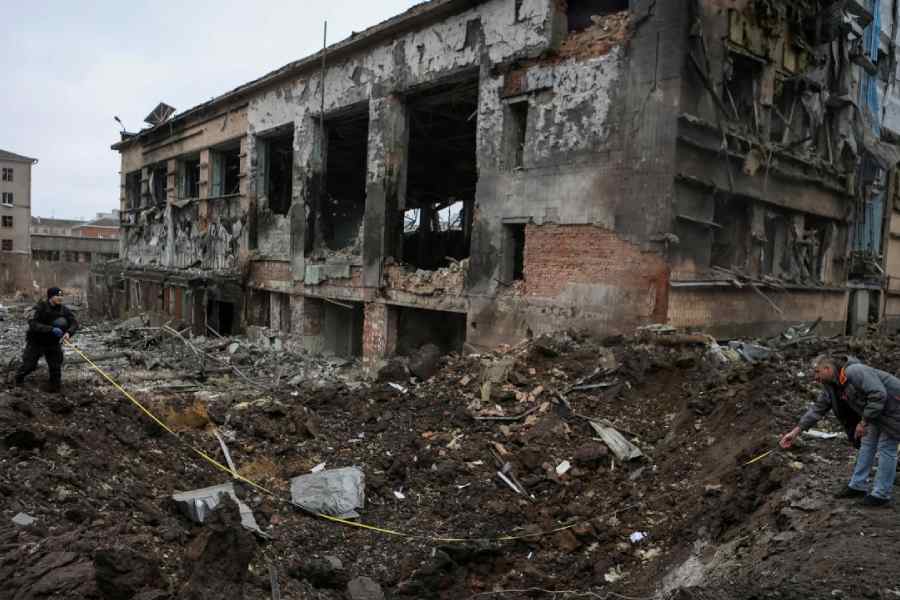
civic structures of a number of cities and towns, thus denying
water (in the heat of summer) and electricity, law and order,
the removal of garbage and other routine civic functions
to thousands of ordinary people whose only crime was not
that they were members of al Qaida or supporters of Saddam
Hussain, and not that they were members of Saddam’s army,
but that they were Iraqis.
They did, indeed, pull down a
statue of Saddam. This was broadcast live round the world,
and must have had the rednecks in the US cheering wildly.
To them that must have been a major triumph, one which will
no doubt get many US soldiers the Purple Heart or whatever
medals they give to their bravest. They actually pulled
down a statue, using a tank. In one of the Bond films (Goldeneye,
I think), Pierce Brosnan uses a tank — a Russian tank,
true, but a tank nonetheless — to smash through a statue
of a Pegasus-like creature which then rides through the
streets of St. Petersburg on top of the tank till an inconveniently
placed building knocks it down. Tanks are very useful to
pull down statues, as Pierce Brosnan on his own, and the
intrepid American armoured unit which pulled down Saddam’s
statue, have shown the world.
They also did a Hollywood-style
rescue of a young, blonde and pretty US private, Jessica
Lynch, but unfortunately that was exposed as a publicity
stunt enacted for the benefit of the wildly cheering rednecks
in America, and their counterparts in Britain. Not only
was the rescue staged for the cameras, they actually came
close to killing her off when the well-meaning Iraqi doctor
in the hospital sent her in an ambulance, obviously clearly
marked as one, to a US check point. The American troops
opened fire on it — no question asked, no warning to go
back, nothing. But that was understandable; the soldiers
were very frightened of suicide bombers; one or two of them
might actually have been killed by an evil suicide bomber,
so opening fire on the ambulance was all right.
The ambulance hastily returned,
and amazingly, the American troops, who must have used very
sophisticated weapons which shoot zillions of rounds a second,
couldn’t even hit it! Very very frightened, the soldiers
must have been. But there was one thing they did which deserves
admiration and praise. This was the embedding of journalists.
Selected journalists were made part of military units, dressed
in uniform, and they actually were present during whatever
action the military took. This had never been done before,
and, from the point of view of military PR, it was a brilliant
thing to have done. There were the usual briefings, of course,
but what could match the pictures and reports from journalists
who were seeing it right as it happened?
Just consider the following. First,
they could select which journalist they wanted where. (Maybe
they didn’t actually select them, but it would be silly
to think they wouldn’t, say, discuss possible choices, with
editors and news managers.) Second, the embedded journalist
would be so caught up in reporting the actual details that
he wouldn’t really have the time or opportunity to comment,
leave alone comment critically. In any case, critical comment
was out; how could you possibly be critical of soldiers
you were staying with, eating with and chatting with? Which,
of course, the spin specialists in the Pentagon would have
known from the start. Third, and this was the really clever
bit, even the editors and television analysts whose journalists
were embedded couldn’t be critical or anything but supportive
— after all, their people were there, with the troops. Hostages,
if you like.
Was it surprising, then, that
everyone, even the Americans, began watching the BBC for
what they considered the real news? Was it surprising that
the BBC correspondent, Rageh Omaar, became a symbol of unbiased,
on-the-spot reporting from Baghdad, not embedded with a
convenient army unit? Of course, once there was a general
realization of how widely his reports were being watched,
there were some clumsy attempts to trash him with planted
stories of how he tried to curry favour with the Iraqi authorities
— attempts that stopped abruptly when those responsible
for them realized that they were having no effect.
A BBC producer who was also working
independently without becoming the kind of icon Rageh Omaar
did is Stuart Hughes. He had to have his foot amputated
after being in a landmine blast. Hughes says, “News organizations
have realized how successful embedding has been — it’s a
particularly good way for getting footage — but it would
be a dangerous conclusion to rely solely on embedded reporters.”
He is not wholly against it, and adds, cautiously, that
embedding has worked, but that “its limits have not yet
been tested”. He adds, “We will always need people on the
ground independently forging ahead, finding the stories.”
He dismisses his own injury, saying
“if someone crashes his car on his way to work you wouldn’t
ask him if he’d ever drive again.” But whatever the outcome
of the debate on embedding journalists elsewhere in the
world, there is a lesson to be learnt from what happened
in Iraq. Hopefully, we will not have another war here on
the subcontinent, but if we do, even if it is a limited
conflict, it needs to be realized that embedding — when
the adversaries are not as ill-matched as the American-led
forces and the Iraqis, but more or less equal in strength
— brings with it grave risks to the journalists with fighting
units, who may well be killed or taken prisoner. Worse,
the reports they will send will give not just the people
but also the senior commanders a picture that may well be
wrong and lead to dreadful consequences.
Independent coverage will always
be a risky business. Even in the one-sided Iraq conflict
13 reporters, cameramen and other media-workers lost their
lives, and many more were injured, like Stuart Hughes. But
it has to be the mainstay of any coverage that a news organization
provides of an armed conflict. There will be some who will
argue that such independent coverage may not get the cooperation
they would need from the military. But this argument will
not hold, for one very good reason.
Whatever they may say about independent
media coverage, our Indian defence authorities will, in
actual fact, give it the cooperation it seeks, if for no
other reason than to eliminate the possibility of negative
stories being sent back. This does not mean that reporters
who feel that they are not getting the cooperation they
want from the military will immediately say that we are
doing badly when we are not; but they may well say that
the authorities refused to confirm or deny such and such
report, and that, in itself, may have an adverse effect
not just on people watching or reading such reports, but
eventually also on those actually engaged in the fighting.
That is something military commanders will not risk. And
let us not forget that the journalists who risk their lives
to cover a conflict are not immediately self-serving unpatriotic
people, as they have sometimes been called by angry military
authorities.
It is not a question of patriotism,
it is a question of what they are in the business for, and
for which they are willing to risk their lives: the truth,
which may sometimes be painful, but which needs to be reported
as it is.
|