|
As
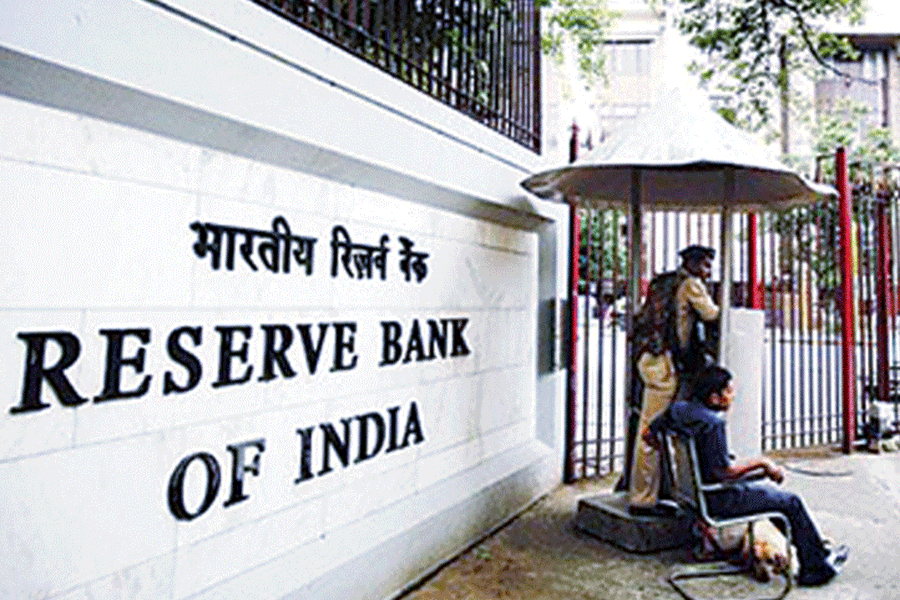
I write this, the Reserve Bank of India governor, Bimal Jalan, has just released
the monetary and credit policy for 2003-04. The policy document contains a number
of measures to facilitate the smooth functioning of the entire financial sector.
But, the key features that affect the entire economy in a big way relate to policy
changes relevant to the flow of credit and the structure of interest rates. Jalan
announced two major policy changes of this nature — the bank rate has been lowered
from 6.25 per cent to 6 per cent, while the banks’ cash reserve ratio has also
been lowered to 4.5 per cent. The bank rate and
the CRR are two major policy instruments through which the RBI tries to influence
the volume of credit in the economy. The bank rate is the rate at which commercial
banks can borrow from the RBI, while the CRR stipulates the fraction of deposits
that the commercial banks have to maintain as minimum reserves with the central
bank. A reduction in the bank rate lowers the cost of borrowing for commercial
banks and so encourages them to increase the supply of credit to the economy.
Often, a lower bank rate also translates to a lower interest structure, with banks
reducing both lending and deposit rates. Similarly, a lower CRR also increases
the availability of credit in the economy. One
newspaper reported that the RBI has taken these steps in order to ensure that
the Central government does not face any major obstacles in fulfilling its borrowing
programme. Indeed, if the economy actually moves to a lower interest rate structure,
this would also mean that the government’s cost of borrowing would be that much
lower. This would be a tremendous boon to the Central government (and to state
governments too) since debt servicing is an increasingly heavy burden for them. However,
although the Central government is the most important economic agent in the economy,
the actions of the central bank of the country must be justified by how these
affect the overall economy, and not just the fortunes of the central bank. After
all, that is why it is so important to preserve at least a modicum of autonomy
for the central bank — it cannot be a wing of the finance ministry. Is
an increase in the availability of credit and possibly at lower rates of interest,
good for the overall economy, given the prevailing conditions today? Obviously,
that depends on whether Jalan and the RBI believe that the extra credit availability
will stimulate growth. For this to happen, there must be adequate demand for credit
in the economy so that the availability of credit in the absence of these policy
changes would act as a constraining factor preventing entrepreneurs from carrying
out their investment plans, or households from financing spending decisions. On
the other hand, if credit is not in short supply, then increases in credit availability
cannot have any appreciable impact on rates of growth. The
Central government does seem to have an insatiable demand for credit to finance
its deficits, and there is always the danger that government borrowings may “crowd
out” private entrepreneurs’ borrowings. In other words, the private sector may
find it hard to finance its spending programmes because the government takes up
a large fraction of the overall supply of credit. If this is a correct description
of the current economic situation, then the policy changes announced by the RBI
make sense. Of course, the demand for credit from
the private sector and indeed whether there is any danger of crowding out depends
on whether entrepreneurs are eager to carry out new investment projects. During
times of sluggish economic activity, entrepreneurs are likely to be unenthusiastic
about undertaking new investment projects. Of course, expectations also play a
major role. Even if the economy is at a low level of activity perhaps because
of some temporary adverse phenomena, entrepreneurs may still feel optimistic about
the future, and so be eager to expand capacity or branch out into new activities.
This implies that expectations about future rates of growth may be an important
determinant of the demand for credit. There are
different projections about the future growth path of the economy. The RBI itself
is rather bullish about the short-term prospects of the economy. Roughly a week
before releasing the monetary and credit policy, Jalan announced that the economy
was likely to grow at 6 per cent during this fiscal year. This is based on the
meteorological office’s prediction that the monsoon rains during June-September
will be 96 per cent of the normal amount. The RBI seems to believe that a reasonably
good monsoon and the consequent revival of agriculture will ensure a satisfactory
rate of growth. Other projections are more pessimistic, and contend that much
depends on how the global economy adjusts after the United States of America’s
invasion of Iraq. If the more pessimistic projections
are correct, then the greater availability of credit will not be of much productive
use. Some critics have gone to the other extreme and suggested that the easier
availability of credit may actually exacerbate the inflationary pressures in the
economy. However, Jalan feels that these dangers have been exaggerated. According
to him, the current high rate of inflation is due to the sharp rise in prices
of a few items such as edible oils and petroleum products. Once
petroleum prices settle down to levels prevailing before the onset of hostilities
in Iraq and if the monsoon brings down edible oil prices, then the level of inflation
will cease to be much of an issue. It should also be kept in mind that the economy
is far from being overheated, and so easier availability of credit is unlikely
to have any significant impact on prices. The RBI
governor also hinted that interest rates were unlikely to fall much further. This
is likely to be scant consolation to pensioners and others who are dependent on
interest incomes — they feel that deposit rates are already too low. If the rate
of inflation cannot be brought down, then these views become more persuasive since
real rates of return are dangerously low. But, with elections just round the corner,
can government largesse be very far away? |