|  |
Elephant
& giraffes at the Alipore Zoo | From
Aquatica to the recently launched Clown Town, the city now boasts the A to Z in
amusement parks. But it is the zoo that remains the last word and the first choice
when it comes to having a day out with family. According
to footfall figures for this winter, Alipore zoo is still the number one attraction
for the people of Calcutta. And that too, by four lakh and more. Alipore
Zoological garden director Subir Choudhury says: “We had about 19.25 lakh visitors
over the last 12 months.” Nicco Park vice-president, marketing, Melvyn Pinto puts
ticket sales at about 15 lakh in the same period. As far as the zoo goes, the
2002 figure is a jump of a cool lakh over that in 2001, when it had “around 18.25
visitors”. What is the key to the rising popularity
for the 127-year-old landmark? “We draw visitors not only from the city but from
all conceivable parts of the state. As a matter of fact, we are the only ‘large
zoo’ in the state, as specified by the Central Zoo Authority (CZA). The zoo’s
attraction will always be there. Where else can you see so many animals, many
of them in their natural environment?” asks Choudhury.
| Football
facts | Mammals
375 Birds 1,350 Reptiles 85 Founded in: 1875 Area: 45
acres Visitors at other funspots last year (approx): Nehru Museum
86,000 Victoria Memorial 10 lakh Planetarium 810 lakh Aquatica 5 lakh Nicco
Park 15 lakh Swabhumi 3.5 lakh Clown Town 20,000 in the past two months
|
The secret behind the growing success, says
the zoo director, might be the increase in the number of open-air enclosures during
this time. “Even the rise in ticket prices (from Rs 5 to Rs 10) was not a deterrent,”
he added. Sanjay Maheshwari, director of Clown
Town, the youngest amusement centre of the city which boasts a state-of-art go-karting
track and the city’s only ice skating rink, agrees with the zoo director’s contention.
“We can’t compete with them. The attraction of live animals is immense to people
of all sections and age-groups, especially kids. I think the newly-opened modern
amusement centres actually eat into the popularity pie of the museum and Victoria
Memorial,” he points out. The footfall also follows
a specific pattern. According to zoo sources, almost half of the annual visitors
come to the zoo in December and January. “In the past two months, we have had
more than 11.5 lakh visitors,” says Choudhury. The peak is reached on holidays
— December 25 and January 1 — with gate figures often touching 50,000. This year,
the spate of rallies organised by various political parties acted as a bonus,
boosting ticket sales further with people from the suburbs preferring entertainment
of a different kind. Buoyed by the success, the authorities at Alipore are planning
to build an open-air enclosure for Asiatic lions. Finances, at least in part,
have already been cleared by the CZA . — Jayanta Basu France
unplugged
Good news for lovers of French literature.
In a market starved of the latest titles from the land of le tour d’eiffel, a
collaboration between the Embassy of France in India and Rupa & Co promises
to fill in the blank. A new collection, christened Rupa France, has been launched
to make modern French works available in the Indian market. The
first book of the series, Anti-Memoirs by Andre Malraux, France’s leading
anti-Fascist writer of the 1930s, was launched by cultural attaché to India Jerome
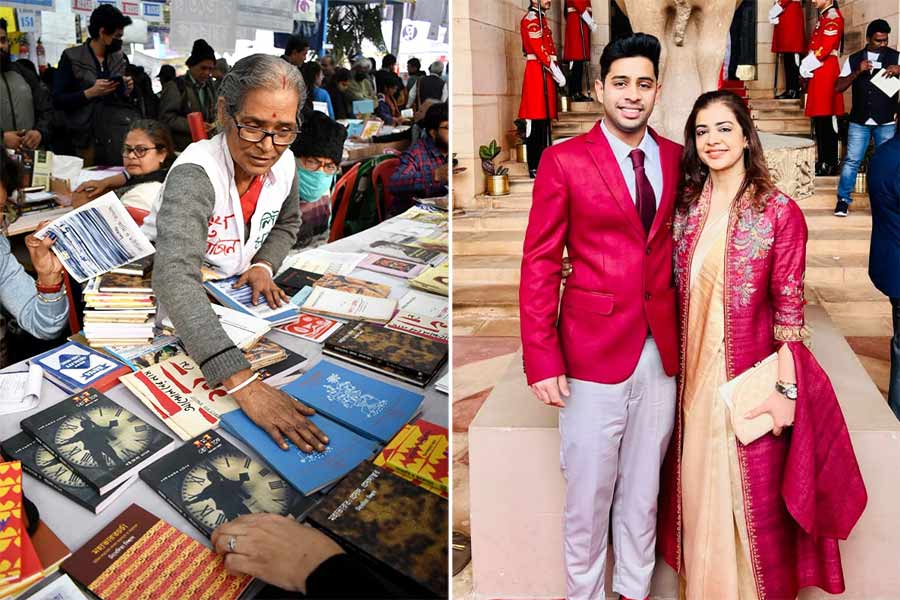
Neutres at the Alliance Francaise de Calcutta stall at the Book Fair. “We started
with Malraux as 2003 marks his centenary and is being celebrated as the Malraux
Year in India. There are plans to bring out four books every year, with Daniel
Pennac, Louis-Ferdinand Céline and Didier Daeninckx already lined up for release,”
informs Myriam Rasiwala of the embassy. Adds R.K. Mehra of Rupa: “Our association
with French authors started with the Model Anthology of French Poetry published
last year. The aim of this new series is to reach to readers all the books that
have been out of print or are available in prohibitively priced international
editions.” The effort is being aided by the Tagore programme of translation that
the French government has undertaken, which assists both French and Indian publishers
and translators. In
tune with the Cup
With World Cup fever running
high, almost every corporate label is keen to cash in. The latest to join the
Cup chorus is Virgin Music, which has released a special song, Humko To Hai
Poora Yakien, to buoy the spirits of Sourav Ganguly and gang in South Africa.
Produced
by MSN India with Virgin Records India, Humko To Hai Poora Yakien is a
rendition by some of the biggest names in the Indian music industry, “showcasing
the entertainment world’s dedication to the world of cricket and the heroes of
the nation”. The song, with its video made by Mahesh Manjrekar, was launched this
week. Through Humko…, Virgin has brought
together singers like Shubha Mudgal, Shankar Mahadevan, Shaan, Sudesh Bhosle,
Sunidhi Chauhan, KK, Sagarika, Shweta Shetty, Shweta Pandit and Shraddha Pandit.
Shameer Tandon, marketing controller, Virgin Records
India and also the composer of Humko…, said: “Virgin Records and MSN co-produced
and conceived this song in March last year. We decided to bring under one umbrella
some of the most talented singers in the country and dedicate it to every Indian
who has done the nation proud.” The lyrics are by Ajay Jhingran. The
music video brings together Sunil Shetty, Sanjay Dutt, Salman Khan, Raveena Tandon,
Mahima Chaudhry, Bipasha Basu, Diya Mirza, Mahesh Bhupathi, Mohinder Amarnath,
Sudesh Bhosle, KK, Arbaaz Khan, Sohail Khan, Salim Khan, John Abraham, Ritesh
Deshmukh, Divya Dutta and Sagarika. Virgin Records
has also produced a techno version for the song to suit discotheques and parties.
Music
Mela
 |
| Fossils
belts it out at MusicMela 2003. Picture by Aranya Sen |
It’s the season of fairs, and even as big brother Book Fair hogs the limelight,
there’s something special on for Calcutta’s music connoisseurs as well. MusicWorld’s
MusicMela 2003 on the premises of Academy of Fine Arts, offers a spread of 6,000
titles, including some rare Bengali repertoire, with discounts of 15 per cent
upwards. Inaugurated
by Usha Uthup on January 29, the mela is on till February 9. “A large number of
people from far-flung areas visit the Maidan during this time of the year. The
Mela is an attempt to bring a slice of MusicWorld to them,” says the music store
chain’s regional manager Dipra Jha. As added attraction at the mela, Bangla bands
are making music on the lawns every evening. A
different brush
Contemporary art of Bengal
is not very well represented either in the West or north India where many people
are still of the impression that the Bengal school has a stranglehold of the art
of this region, says Ashit Paul, chief convenor of Mukta Shilpa. He is organising
a three-day art workshop at the Academy of Fine Arts from February 10. The
focus will be mainly on installations but artists will be given a free hand. They
can work the way they want and they can use whatever material they choose. Apart
from the freedom of choice, there will be no theme that the artists will be expected
to work around. The participants will be 32 artists
both young and old, and for inspiration they can take their pick of the verse
of 32 poets. It will be for them to choose a particular word or line that will
be their starting point. Translations of the Bengali poems will be available in
English. Among the artists and sculptors are Manik
Talukdar, Janak Jhankar Narjery, Adhip Datta, Atin Basak and Sunil Das. Among
the poets are Sunil Gangopadhyay, Amitabha Dasgupta, Namita Chowdhury and Mandakranta
Sen. There will be poets from Bangladesh, too, such as Al Mahmud. “They will be
expected to work with a fresh mind and break out of the traditional mould,” says
Paul. Artists will also be encouraged to paint
on clothes, telephone sets, umbrellas and doors and windows. Things of everyday
use will turn into works of art. Mukta Shilpa intends to show the works in Mumbai,
Delhi and perhaps Bangladesh. This is the first time that such a workshop will
be held at the Academy. This is in keeping with the Academy’s new policy of reviving
the cultural activity and ambience for which it used to be famous once. |